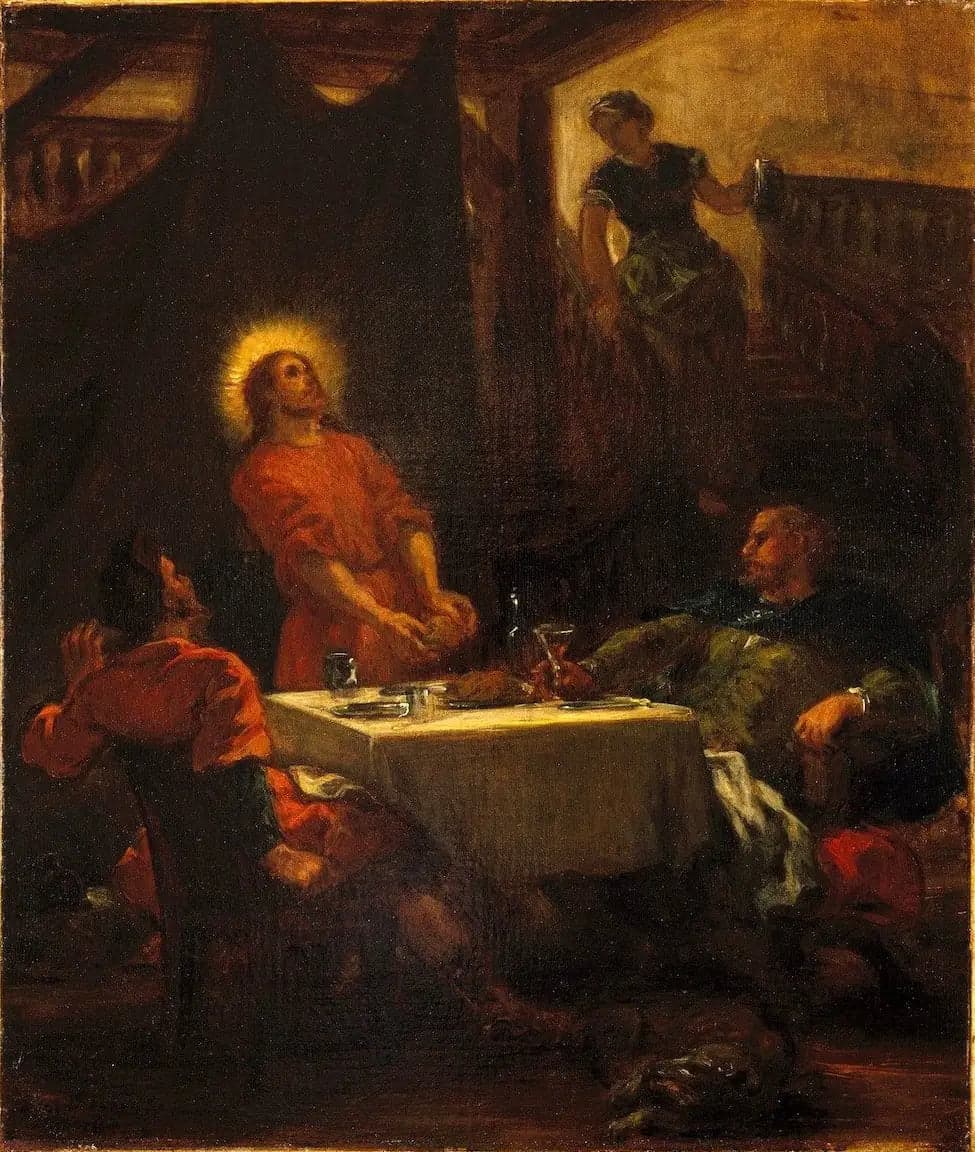
The Disciples of Emmaus, or The Pilgrims of Emmaus
- Original dimensions
- 47 x 55.2 cm
- Museum
- Brooklyn Museum
- Year
- 1853
Scene depicted
The painting represents a pivotal moment from the Gospel, when Jesus reveals himself to the disciples after his resurrection. Around a modest table, the disciples express euphoric joy and intense devotion, instantly recognizing their Lord. It is a scene rich in emotions, where light plays a crucial role, accentuating the fervor of this moment inherited from sacred texts.
Historical context
Created in 1853 in Paris, this painting emblematic of the Romantic movement evokes a turning point in the history of art. The painting is currently housed in the BROOKLYN MUSEUM , where it continues to fascinate visitors with its expressiveness and timeless charm. Here, Delacroix, the undisputed master of light and color, captures the mystical moment of the Pilgrims of Emmaus, a symbolic moment of revelation.
Place in the artist's career
The Disciples of Emmaus represents a crucial step in Delacroix's career, marking his ascent towards bolder compositions. Alongside Liberty Leading the People and The Massacre at Chios , this canvas testifies to his evolution not only technically but also emotionally, transposing scenes of history and faith with unparalleled power.
Anecdote
“A pictorial work should not only be seen, it should be felt.” These words resonate like the echo of a spring morning, where Delacroix, wandering the streets of Paris, was inspired by the soft light filtering through the blooming trees. It is this same light that dances on the faces of the disciples in The Disciples of Emmaus , becoming a symbol of recognition and divine revelation.