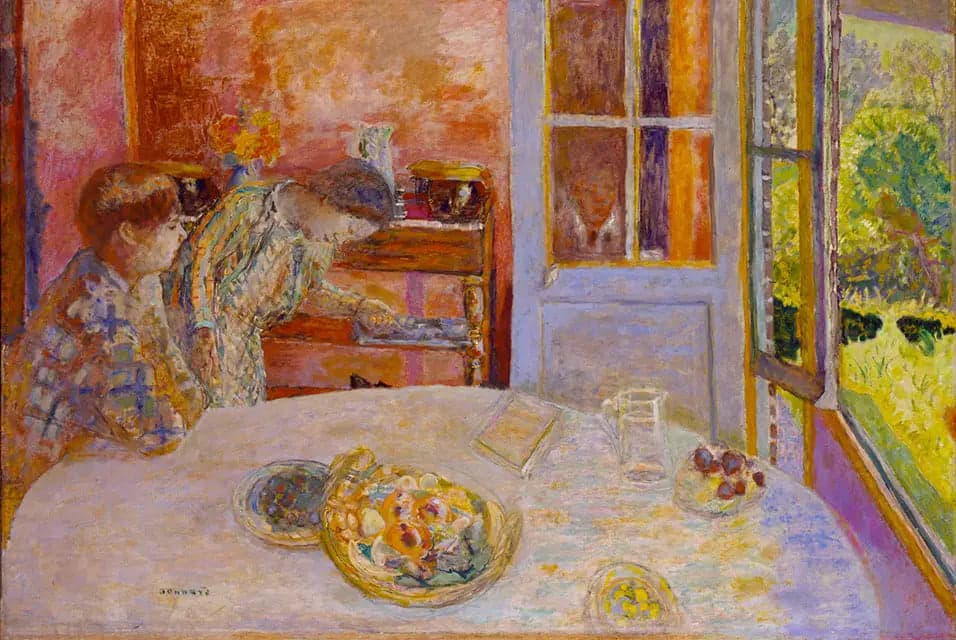
The Dining Room
- Original dimensions
- 100 x 84 cm
- Museum
- Virginia Museum of Fine Arts
- Year
- 1943
Scene depicted
In “The Dining Room,” the magic happens at first glance. The composition invites you to discover a space filled with warmth and authenticity. The play of light illuminates the canvas , paying homage to the details of everyday life. This painting testifies to a shared meal, where the guests engage in a silent dance of gentle gestures and knowing exchanges. Every element, whether it be the objects on the table or the reflections on the walls, informs the place where art and life meet.
Historical context
Created in 1943, amidst the turmoil of World War II, this painting embodies its origins in the wonderful artistic exhibition that France was experiencing. Pierre Bonnard , a fervent representative of the Nabi movement, managed to capture on his canvas an intimate atmosphere, reflecting the simple joys of domestic life. Currently, this sublime painting is preserved at the Virginia Museum of Fine Arts , a region bathed in light and the beauty of landscapes.
Place in the artist's career
This painting holds a privileged place in Bonnard's career, revealing his artistic evolution. Through earlier works like “The Lunch” and “The Terrace at Vernon,” one can observe a growing sophistication. “The Dining Room” serves as a stylistic peak, where the artist, slotting the influences of Post-Impressionism , merges reality and emotion, thus enriching his visual palette with unexpected nuances.
Anecdote
“The truth of a scene lies in the moments that cannot be touched,” Bonnard might have said while observing a meal among friends. It is a small morning, wrapped in golden light, when he gazed upon this dining room filled with vibrant colors. Every detail of this painting evokes simple memories: the clinking of cutlery, the scent of warm bread, and the sound of laughter. These moments have nourished the evocative power of The Dining Room .