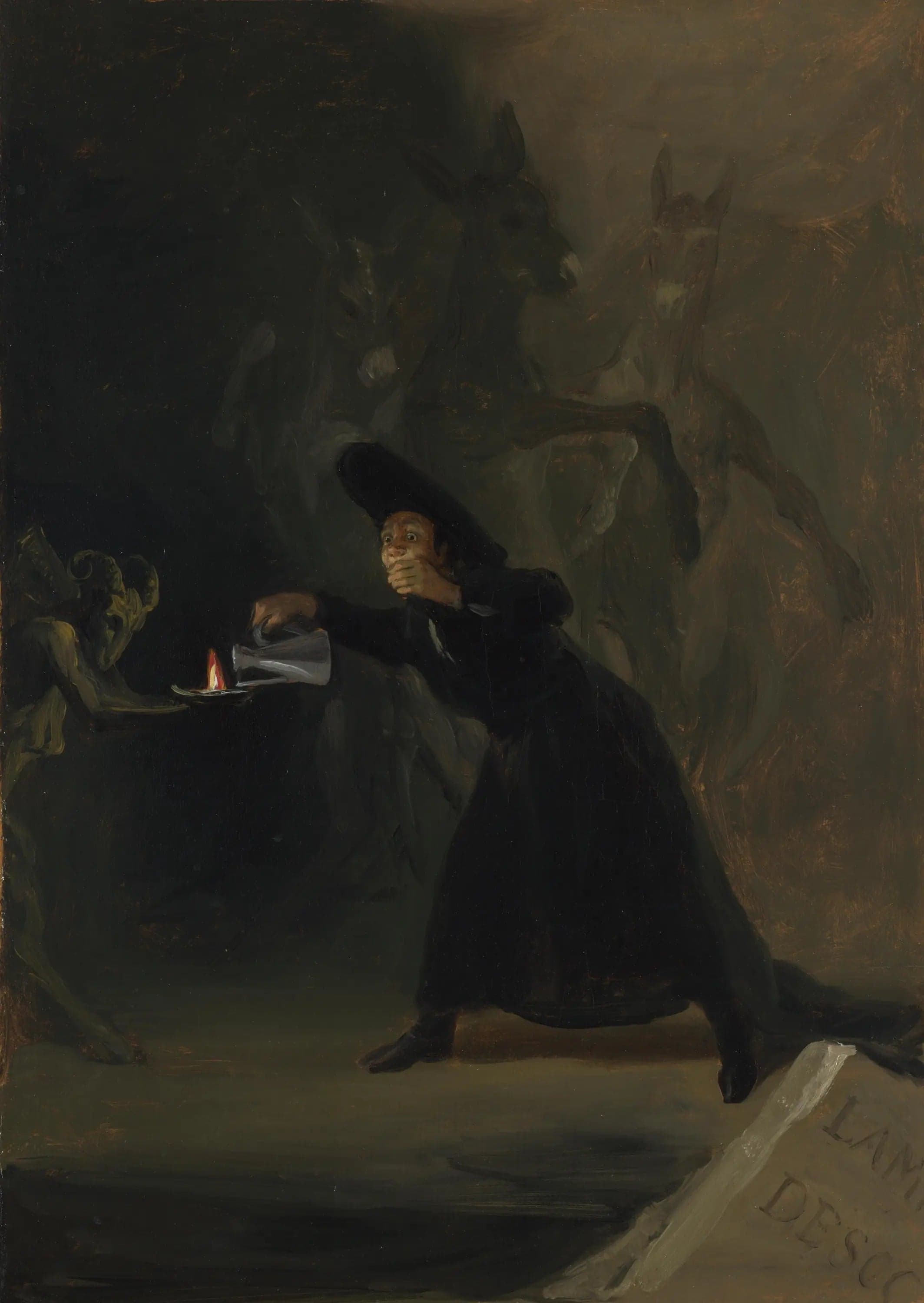
The Devil's Lamp
- Original dimensions
- 30.8 x 42.5 cm
- Museum
- National Gallery
- Year
- 1790
Scene depicted
In this poignant work, Goya illustrates a striking moment, where a devilish hand seems to control the light, casting a disturbing shadow on an anguished face. The painting evokes the dualities of man, between light and darkness, between illuminating knowledge and mortifying ignorance. The presence of the devil in the form of a lamp underscores the exploration of ethical and psychological themes that still resonate today.
Historical context
Created in 1790, in the heart of Spain, this painting is emblematic of the dark romanticism movement, foreshadowing the turmoil of the contemporary period for the artist. The painting is currently housed in the National Gallery, an ideal setting to capture the disturbing essence of this canvas that questions the viewer about the darkest aspects of the human soul.
Place in the artist's career
This canvas , among Goya's most significant works, represents a major turning point in his career. At this time, the artist was experimenting with various techniques, as evidenced by his other emblematic works, such as “The Maids of Honor” and “The Family of Charles IV.” This composition highlights not only Goya's stylistic evolution but also his growing engagement with the sociopolitical troubles of the time.
Anecdote
“I paint what I see and what I feel, where light collides with darkness,” Goya might have said while unveiling this masterpiece . Imagine him, isolated in his studio, one spring morning, his palette vibrating with the echoes of the city's whispers, imbued with a vigorous need to translate the naked truth, the invisible that shapes the human condition, from a narrow window into a constrained world.