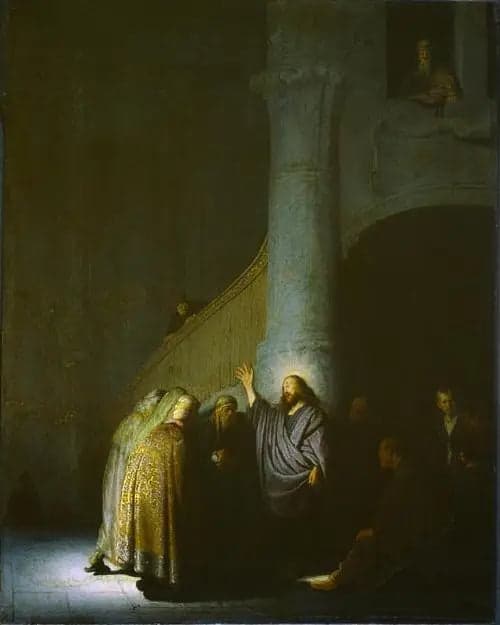
The Denarius of Caesar
- Original dimensions
- 32.8 x 41.8 cm
- Museum
- National Gallery of Canada
- Year
- 1631
Scene depicted
In this painting , Rembrandt stages a captivating dialogue between Christ and the Pharisees. The denial of Caesar, a crucial question, depicts a moment where authority meets divine wisdom. The expressions of the characters reveal deep emotions, creating a palpable tension within the composition. This pictorial work is a reflection on morality, duty, and the dilemmas of the human condition.
Historical context
Created in 1631, this exceptional painting is set against the backdrop of the Dutch Golden Age, a period marked by unprecedented artistic flourishing. At that time, the city of Amsterdam, with its sparkling canals and cultural vibrancy, served as the backdrop for this masterpiece. The painting, now displayed at the National Gallery of Canada , offers a window into a world where light and shadow engage in an eternal dance.
Place in the artist's career
Positioning The Denarius of Caesar at the beginning of his career, Rembrandt already shows a rare mastery. Both his painting with Louis de Geer and the scene of the Holy Family testify to a fascinating evolution. This painting marks an important milestone towards artistic maturity, where he began to play with light and emotion in unprecedented ways.
Anecdote
Rembrandt , who often said, "Light is my accomplice," was inspired during a journey through the bustling markets of Amsterdam. One spring morning, as the mist slowly lifted, he studied the faces of passersby and human interaction, a prelude to the conception of this canvas emblematic. Each brushstroke in the painting is imbued with this softly captured luminosity and raw emotion, the signature of his talent.