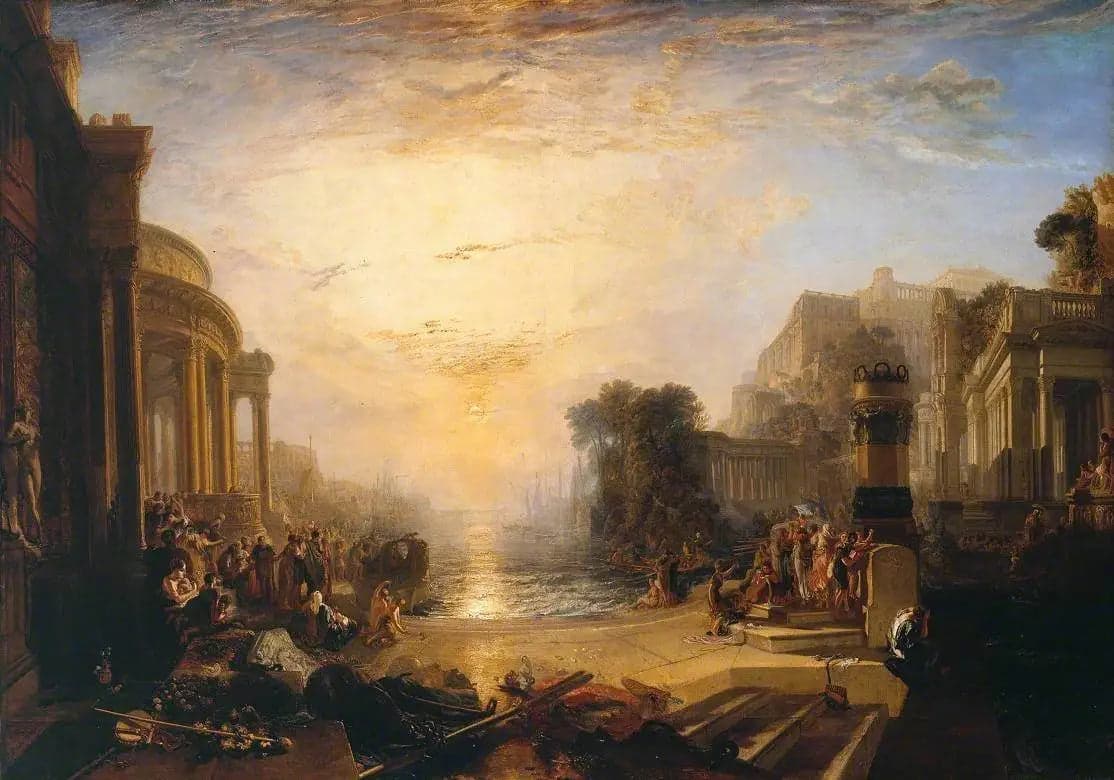
The Decline of the Carthaginian Empire
- Original dimensions
- 170.2 x 238.8 cm
- Museum
- Tate
- Year
- 1817
Scene depicted
This painting illustrates the tragic fall of a once-majestic empire. The scenes that Turner depicts reveal both the fallen grandeur and the sublime melancholy that permeate the landscape. An atmosphere charged with passion and despair, drawing the gaze through the tumultuous waves that cradle the remnants of a great civilization.
Historical context
Created in 1817, this painting emblematic of J. M. W. Turner is set against the tumultuous historical context of ancient Rome, a time when the echoes of battles resonate through the ages. The painting is currently displayed at the prestigious Tate museum in London, where visitors can admire its impressive dimensions and the evocative power that characterizes it.
Place in the artist's career
The Decline of the Carthaginian Empire represents a pivotal moment in Turner’s career, consolidating his reputation as a master of romantic landscape. Alongside other paintings such as The Storm and The Last Voyage of the Temeraire, it shows an evolution not only technical but also emotional, paving the way for bolder later works.
Anecdote
“Art is a reflection of nature and our souls,” said Turner. That morning, on the shores where Carthage was collapsing, he immersed himself in history, capturing the melancholy of the ruins and the strength of the waves. It is this emotion that flows through every brushstroke of his canvas .