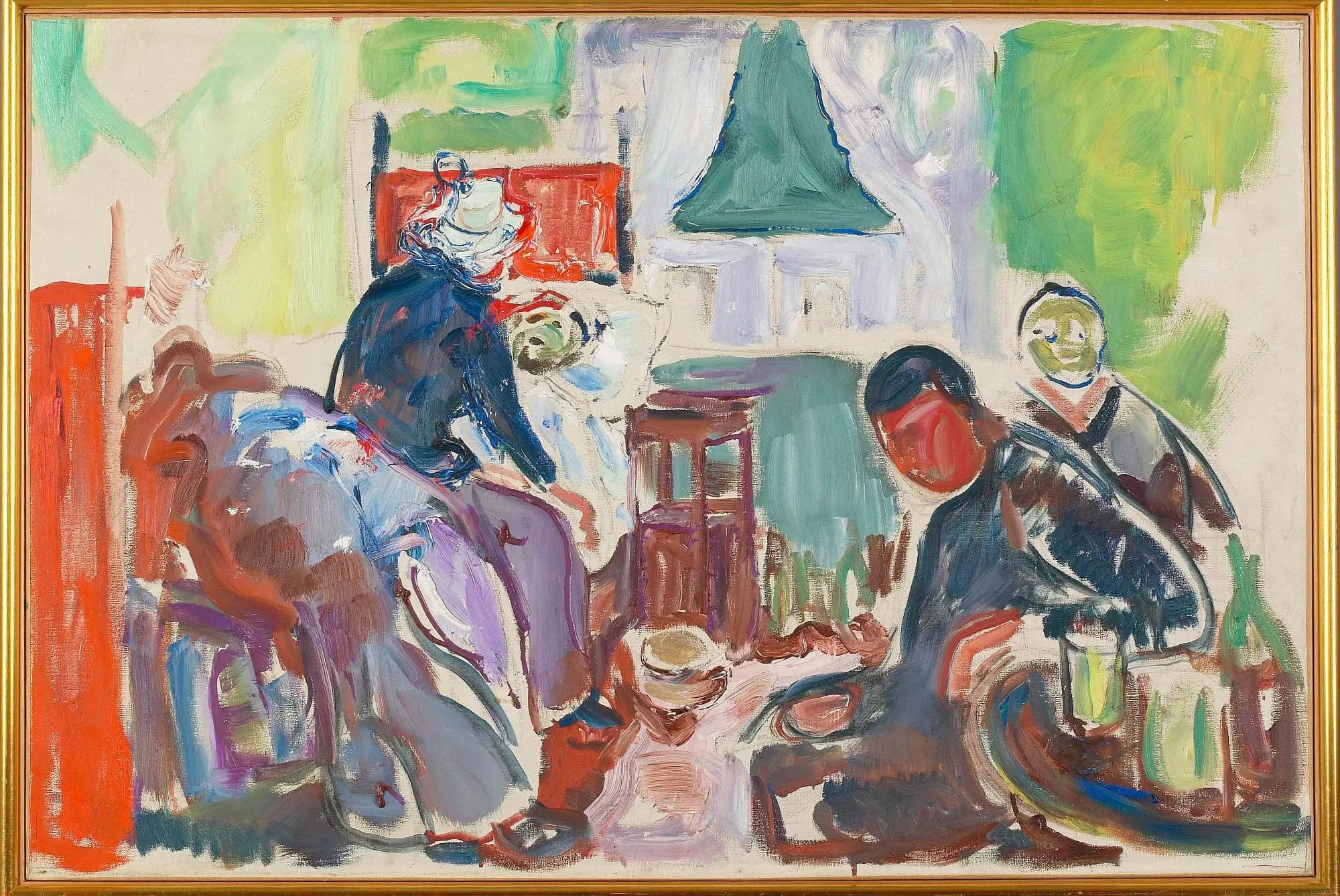
The Death of the Bohemian
- Original dimensions
- 105 x 65.5 cm
- Museum
- Munch Museum
- Year
- 1925
Scene depicted
The canvas “The Death of the Bohemian” immerses us in the heart of a human tragedy. The painting illustrates a man, lying down, surrounded by blurred figures, evoking pain and solitude. This frozen moment, bathed in a gray and palpable atmosphere, transcends the simple act of dying to evoke the struggle of every human being against their inner demons.
Historical context
Created in 1925, this painting is emblematic of the expressionist movement in Oslo. Edvard Munch , a leading artist of the 20th century, delved into the human condition, echoing universal fears and desires. The canvas , preserved in the Munch Museum, represents the very essence of its time, where subjectivity triumphed over realism .
Place in the artist's career
“The Death of the Bohemian” marks a period of maturity in Munch's career. Following “The Scream” and “The Madonna,” this masterpiece illustrates his ability to capture the essence of human anguish. A stylistic evolution occurs here, tracing a path where introspection becomes the guiding star of his art.
Anecdote
“Art must be a space of truth where the soul reveals itself,” Munch liked to say. Imagining the artist, one foggy morning in Oslo, wandering through narrow alleys, inspired by a face encountered, a fleeting glance, is to understand this pictorial work where death, mystery, and beauty intertwine in a tragic dance.