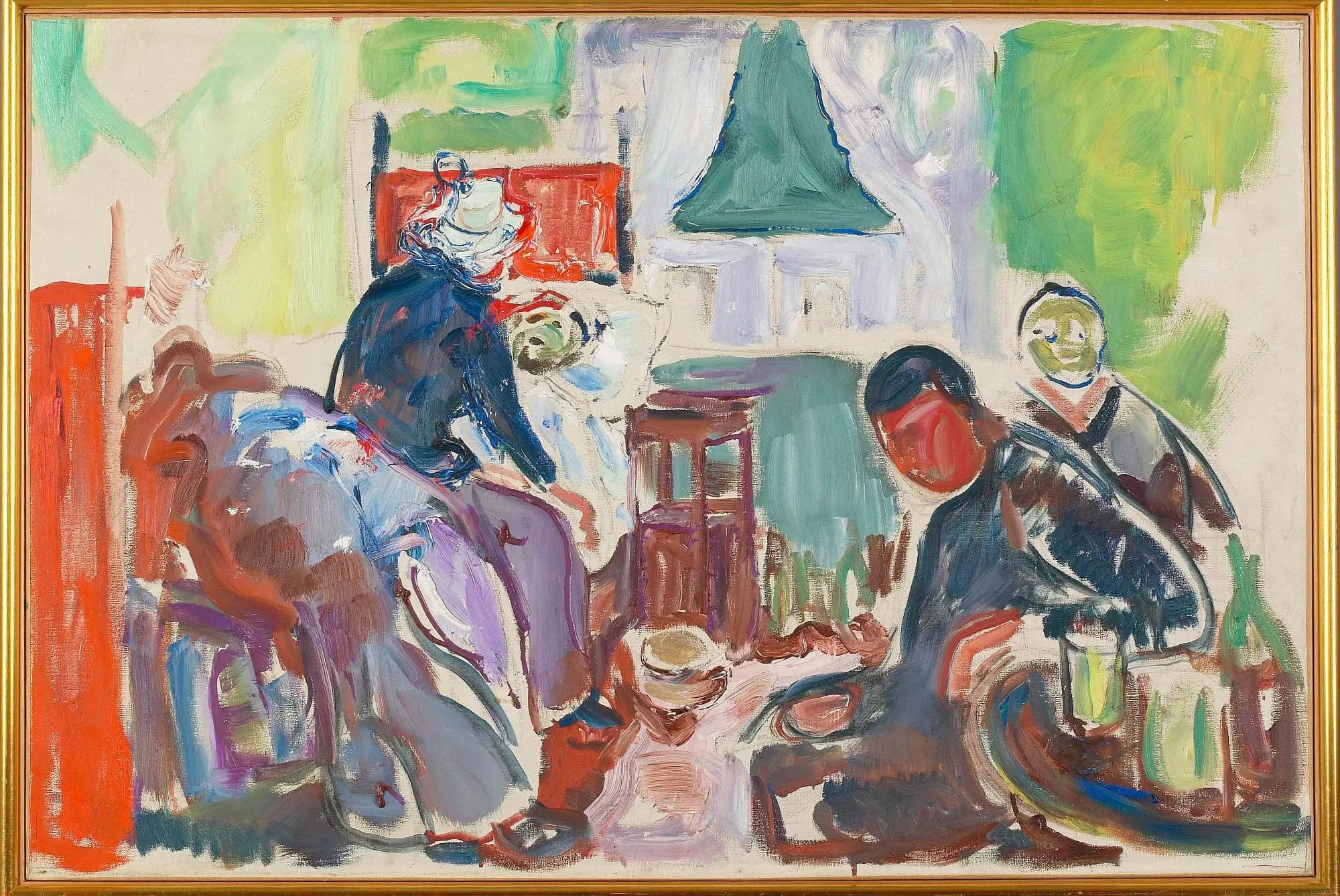
The Death of the Bohemian
- Original dimensions
- 170 x 135 cm
- Museum
- Munch Museum
- Year
- 1915
Scene depicted
In this canvas , Munch captures a poignant scene where death appears as an inevitable companion at the heart of the bohemian life. The lifeless body lies, while unsettling silhouettes surround it. The atmosphere, heavy and tense, is imbued with inner suffering, wandering habits, and unfinished dreams. Through this composition, the artist evokes the sense of loss, solitude, and the search for meaning in a disturbed world.
Historical context
Created in 1915, this iconic painting is fully part of the expressionist movement, an innovative artistic current of the time. Located in Oslo, Norway, this canvas is a vibrant reflection of a troubled modernity. The painting, currently exhibited at the Munch Museum, offers its visitors a dive into the tormented mind of its creator. With its impressive dimensions of 170 x 135 cm, this evocative work captures the essence of an era complicated by conflict and the search for identity.
Place in the artist's career
The Death of the Bohemian represents a significant milestone in Munch's career, a true stylistic peak that illustrates his artistic evolution. Alongside "The Scream" and "The Madonna," this painting showcases the artist's ability to transcend pain through color and form, marking a point of maturity in his work. These paintings , all navigating between light and darkness, offer us a unique vision of the torments of existence.
Anecdote
Munch once said: "Life is a struggle for light." That spring morning, in the heart of Oslo, he crossed the gaze of a stranger whose expression of melancholy deeply marked him. This encounter, meticulously engraved in his memory, resonates in this painting , an ode filled with the intensity of human emotions, where the sublime and the tragic coexist.