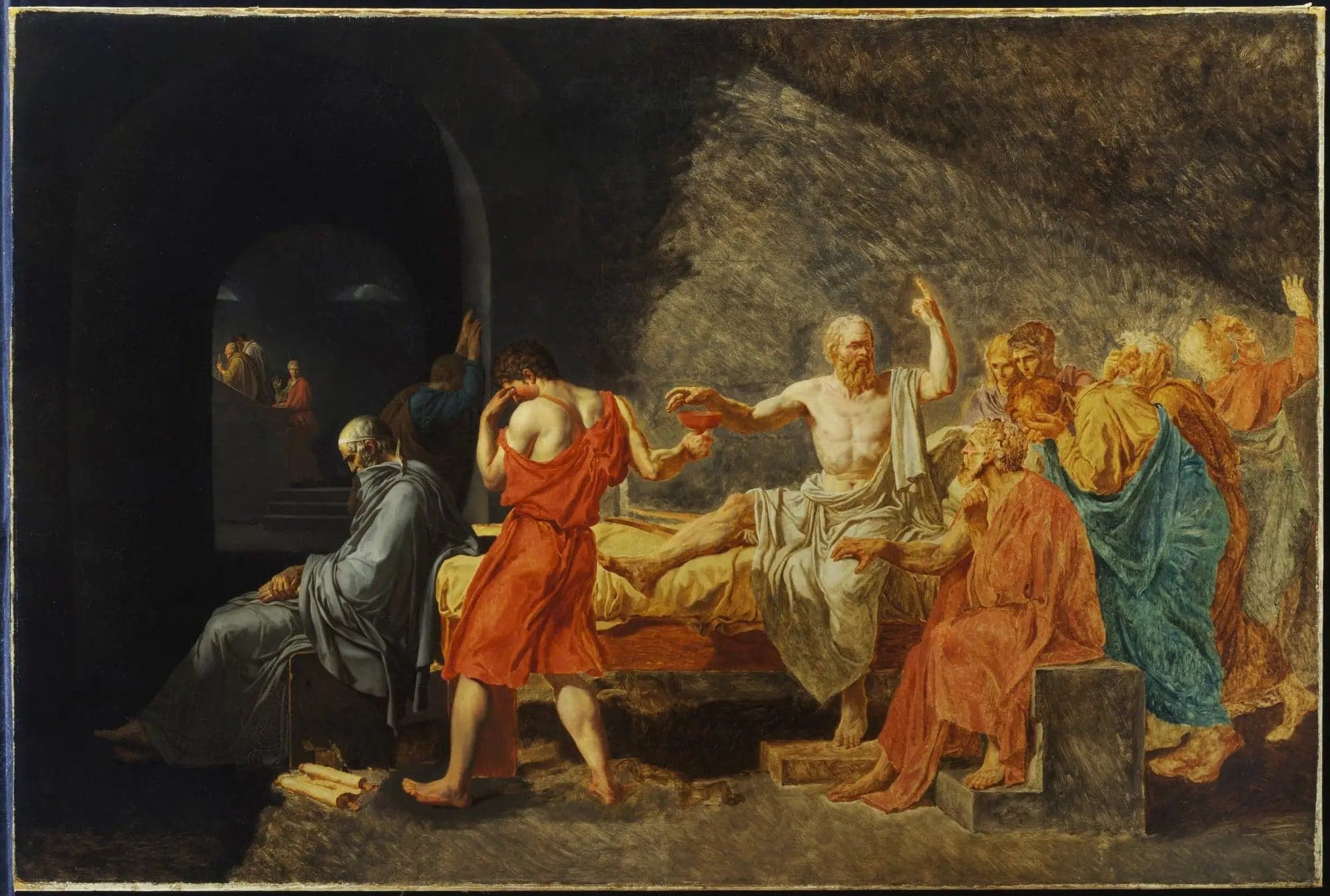
The Death of Socrates - Jacques
- Original dimensions
- 196 x 133 cm
- Museum
- Princeton University Art Museum
- Year
- 1787
Scene depicted
This poignant canvas immortalizes the final moments of Socrates, the philosopher of wisdom, condemned for his teachings. The scene depicts Socrates surrounded by his disciples, accepting his fate with dignity as he holds the cup of poison. The palpable emotion, the faces depicted with realism testify to the impact of these last moments on his fervent admirers, thus marking a universal struggle for truth.
Historical context
Created in 1787, this painting embodies the roots of France, at the heart of the neoclassical movement, which advocates the beauty of Antiquity and rationality. It is within this rich artistic context that Jacques-Louis David , a student of the illustrious Jean-Baptiste-Siméon Chardin, created this masterful work. Today, this exceptional canvas is displayed at the Princeton University Art Museum, where it continues to astonish and inspire generations of visitors.
Place in the artist's career
The Death of Socrates stands as an emblematic painting in the career of Jacques-Louis David . It represents a stylistic peak where neoclassicism fully asserts itself. Through this work, he continues an artistic continuity with his previous paintings, such as The Oath of the Horatii and The Death of Marat, reflecting his technical and emotional evolution over the years.
Anecdote
“Death is the most beautiful of truths, and the beauty of the soul must assert itself in the face of life's anxiety,” David might have declared during the conception of this masterpiece . The artist was inspired by a bright spring morning while strolling through the Tuileries Garden. The soft light, filtered through the leaves, captured his sensitivity, enhancing the dramatically serene demeanor of the hero in his painting .