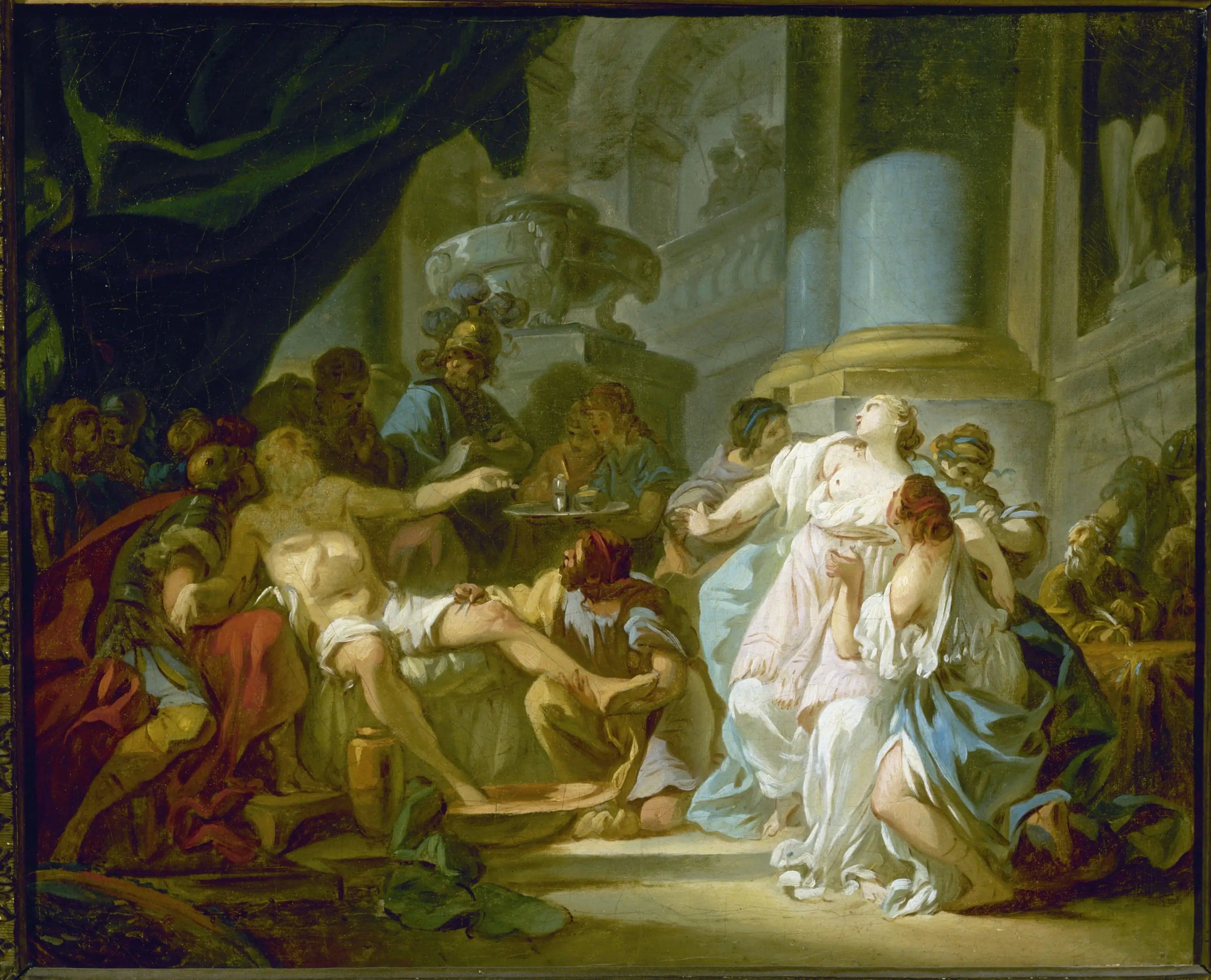
The Death of Seneca - Jacques
- Original dimensions
- 72.5 x 62.8 cm
- Movement
- neoclassicism
- Museum
- Petit Palais
- Year
- 1773
Scene depicted
This painting represents the heroic and poignant moment of Seneca's death, the Stoic, who chooses to end his life with dignity in the face of injustice. In a single striking composition, David captures both the sadness and majesty of the act, illustrating the struggle between power and virtue, placing the viewer at the heart of this drama worthy of the greatest tragedies.
Historical context
Created in 1773 in Paris, this canvas is emblematic of the neoclassical movement. The painting illustrates a tragic moment in Roman history, paying tribute to the values of virtue and moral duty, cherished at that time. Its place of preservation, the Petit Palais in Paris, allows for an appreciation of this work in a rich and historically charged artistic context.
Place in the artist's career
The Death of Seneca marks a turning point in David's career, signifying a stylistic and emotional maturation. Alongside The Anatomy Lesson of Dr. Tulp and The Oath of the Horatii , this canvas demonstrates the evolution of his treatment of themes of heroism and sacrifice, solidifying him as a pioneer of neoclassicism .
Anecdote
Jacques-Louis David , deeply moved by the power of heroism in suffering, once declared: “Art should never be a mere imitation of life; it must exhume its essence, its soul.” This vibrant thought came to him one spring morning as he walked the streets of Paris, reflecting on Seneca's legacy and the depth of his reality. It is this feeling that guided his hand, transforming this painting into a timeless masterpiece .