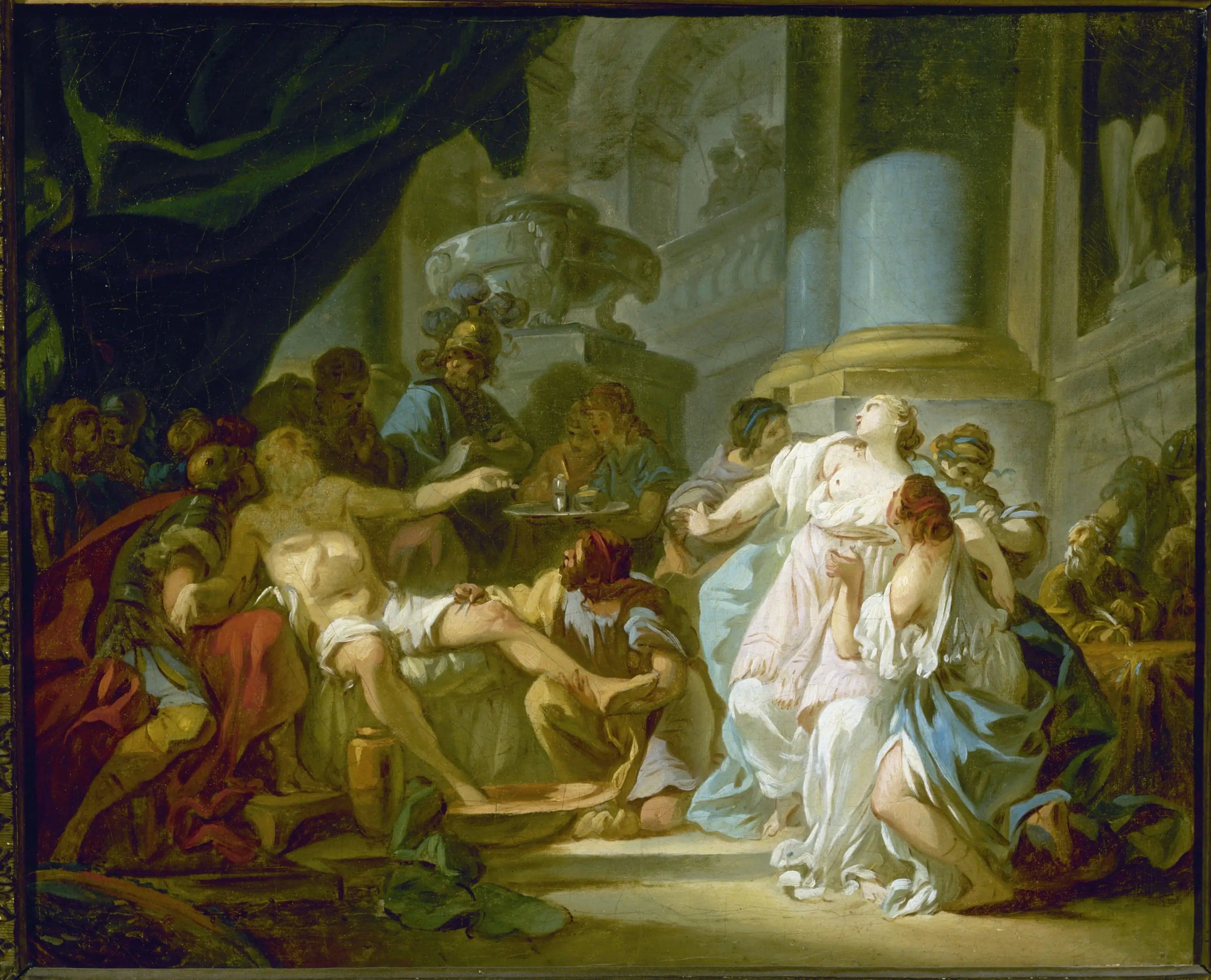
The Death of Seneca - Jacques
- Original dimensions
- 180.3 x 147.3 cm
- Museum
- Petit Palais
- Year
- 1773
Scene depicted
In this painting , the viewer is immersed in the drama of Seneca's death, condemned for attempting to resist the Empire. The atmosphere is heavy with solemnity, as we witness the philosopher's ultimate act of defiance against fate. The faces of the characters, imbued with deep emotions, reveal the power of the moment, capturing the tension between life and death.
Historical context
Created in 1773, this painting embodies its roots in Paris, the beating heart of the neoclassical movement. Inspired by classical ideals and Roman history, this canvas illustrates the decline of greatness during a period marked by artistic and political upheaval. Currently housed at the Petit Palais , this painting evokes the dramatic power of a pivotal moment, measuring 180.3 cm high by 147.3 cm wide.
Place in the artist's career
This canvas represents a crucial step in the career of Jacques-Louis David , heralding his rise to the rank of master of neoclassicism . In parallel, works like “ The Oath of the Horatii ” and “The Struggle of Jacob with the Angel” reveal the evolution of his style, both in techniques, emotions, and nuances.
Anecdote
“Beauty lies in the tearing,” could have said Jacques-Louis David while contemplating the tragic scene. As he sat in his studio, bathed in the fresh light of a spring morning, he perceived the echo of past sufferings, seeing in Seneca a tragic hero. This moment gave birth to a unique pictorial work .