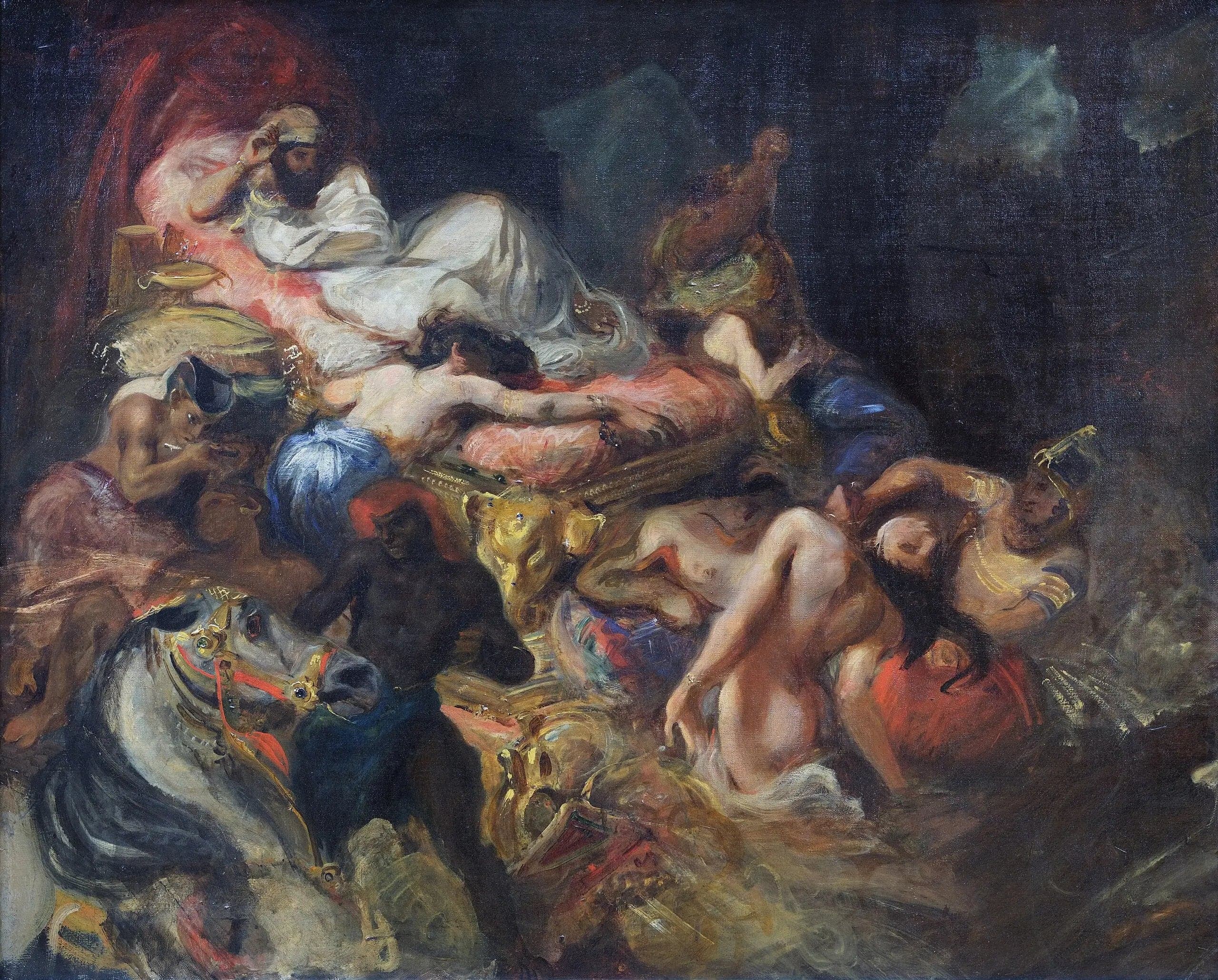
The Death of Sardanapalus, sketch
- Original dimensions
- 100 x 81 cm
- Museum
- room 942
- Year
- 1826
Scene depicted
The tragic composition of this painting traces the desperate choice of Sardanapalus, who prefers to face death rather than capture. Surrounded by vibrant chaos, the figures whirl in a macabre dance, while flames consume his kingdom. Each brushstroke conveys the despair and grandeur of a decisive moment.
Historical context
Created in 1826 in Paris, this iconic painting of the romantic movement is a celebration of drama and emotional expression. The canvas depicts a scene inspired by the story of Sardanapalus, an Assyrian king, and it belongs to a period when art was freeing itself from neoclassical constraints. Today, this painting finds its place in the museum with dimensions of 100 x 81 cm, a receptacle of passion and torment.
Place in the artist's career
Positioned as a stylistic peak in Delacroix's career, this painting echoes his earlier works such as “ Liberty Leading the People ” and his later creations, illustrating a growing mastery of emotions and colors. The strength of this pictorial work testifies to the emotional and technical evolution of the artist.
Anecdote
“A canvas without emotion is a deafening silence,” Eugène Delacroix might have said, as he captured the intensity of a moment. Inspired by a sunny morning while wandering the streets, he encountered a gaze lost in melancholy, a moment that breathed life into the painting that would become a Golden Age of romanticism .
Major exhibitions
Delacroix (1798-1863)