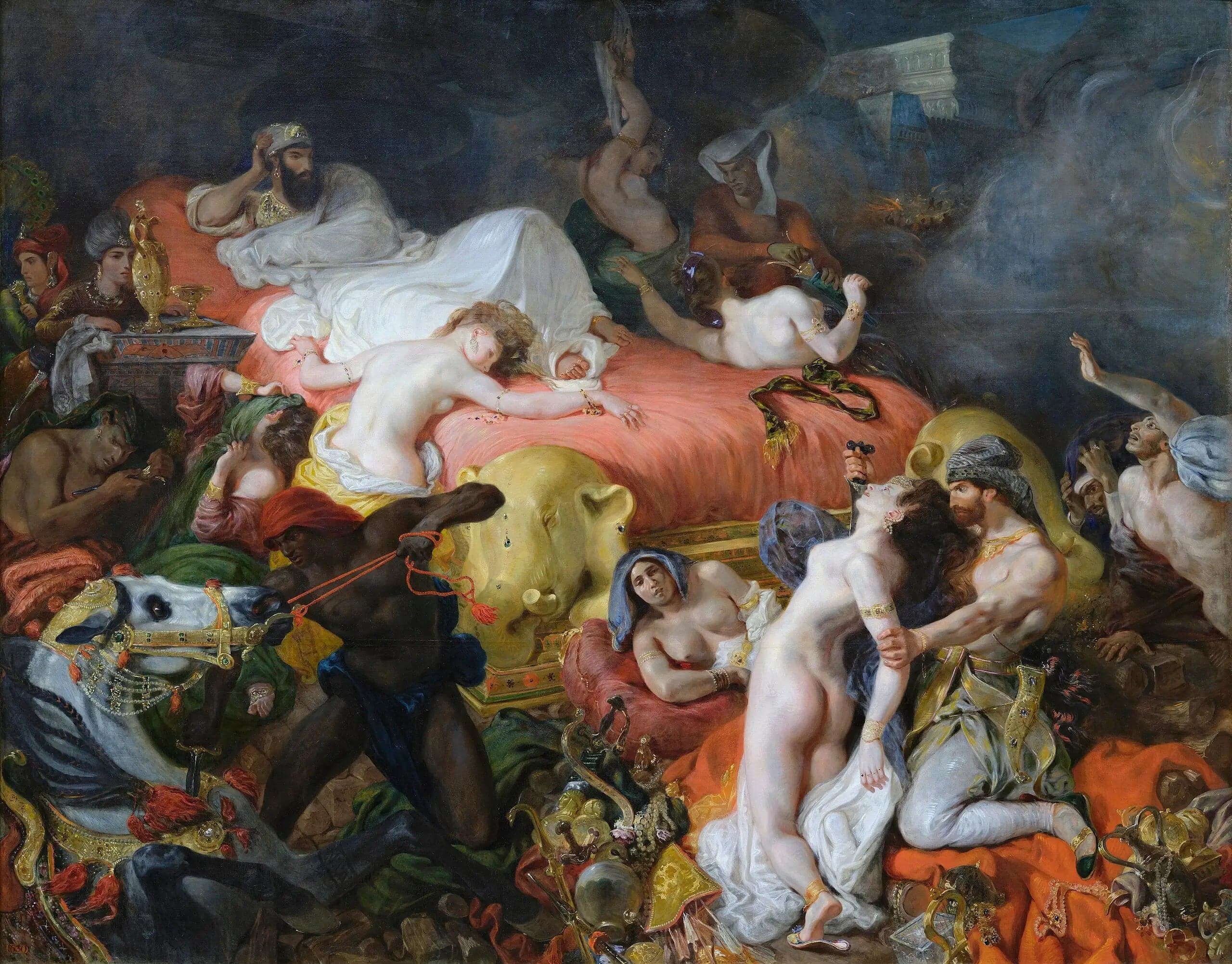
The Death of Sardanapalus
- Original dimensions
- 496 x 392 cm
- Movement
- romanticism
- Museum
- room 700
- Year
- 1827
Scene depicted
This spectacular painting captures the tragic final act of an Assyrian king, Sardanapalus, who chooses death over defeat. Immersed in a chaotic scene blending destruction and despair, each character seems frozen in a macabre dance, illustrating the desperate struggle against an unyielding fate, a cry of emotions that resonates far beyond the limits of the canvas.
Historical context
Painted in 1827 in Paris, this painting is emblematic of the romantic movement, a true reflection of an era marked by intense passions and artistic rebellions. Today, this canvas is wonderfully preserved in a prestigious museum, captivating visitors with its impressive dimensions of 496 by 392 cm.
Place in the artist's career
The Death of Sardanapalus represents a pivotal moment in Delacroix's career, showcasing his artistic maturity. By this time, he had already created prestigious canvases such as Liberty Leading the People and The Massacre of Chios , deeply reflecting his technical and emotional evolution. Each of these masterpieces reveals the nuances of an ever-expanding artistic vision.
Anecdote
“Art is life both awake and asleep.” This is how Eugène Delacroix described the genesis of his masterpiece . Imagine a misty morning in Paris, in a room barely flooded with light, where the artist draws inspiration from ancient tragedies and echoes of human passions. This aura of emotion nourishes the power of The Death of Sardanapalus.
Major exhibitions
Salon of 1827