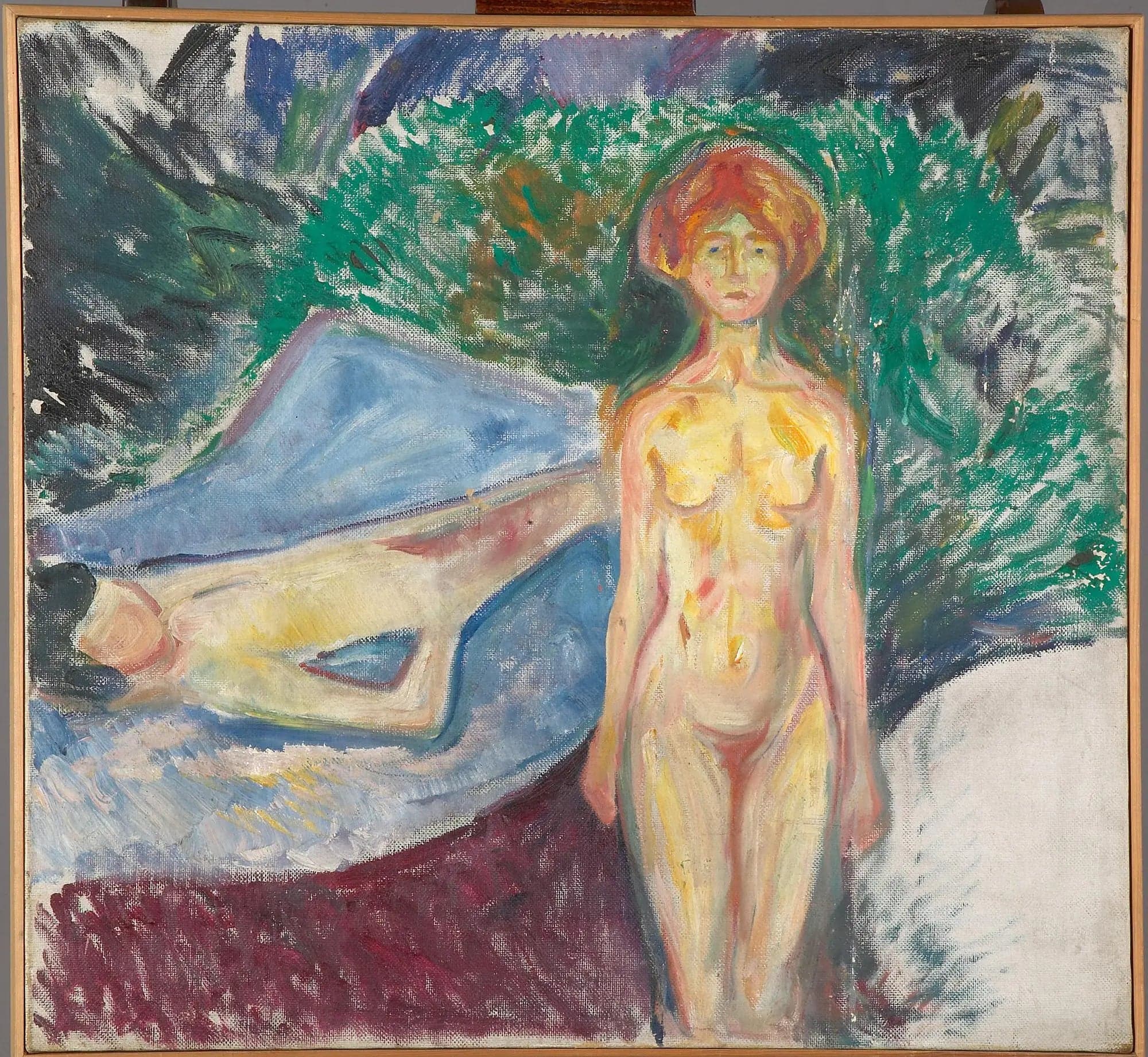
The Death of Marat
- Original dimensions
- 199 x 150 cm
- Museum
- Munch Museum
- Year
- 1907
Scene depicted
In The Death of Marat, Edvard Munch immerses us in the heart of a tragic drama, blending historical reality and deep emotion. The painting depicts the fatal moment of the assassination of Jean-Paul Marat, a key figure of the French Revolution, revealing the tension between light and darkness. Through this painting , Munch transcends mere narrative to evoke emotion through its brutality and morbid beauty.
Historical context
Created in 1907, this painting is emblematic of the expressionist movement. It was conceived in Oslo, a city rich in history and art, at the heart of a time when intense emotions transcended aesthetic conventions. The canvas is now housed in the Munch Museum, where it continues to attract the gaze and reflections of visitors. Its majestic dimensions, 199 by 150 cm, provide a spectacular frame for this unique pictorial work.
Place in the artist's career
The Death of Marat is a fundamental milestone in Munch's career, marking a stylistic peak. Before this work , he had experimented with symbolism and the melancholy of The Night, and afterwards, his style would continue to evolve in pieces such as The Scream. Each of these paintings reveals a facet of human psychology, exploring universal themes that address suffering and passion.
Anecdote
One day, Munch reportedly stated: “The artist must draw inspiration from the shadows of existence.” This quote resonates particularly when considering the emotional force of The Death of Marat. Imagine him, on a blank canvas, capturing the weight of human drama tinged with blood, on a misty morning in Oslo, as he reflects on the fragility of life.
Major exhibitions
Kan hende er det vakkert. Kunstsamleren Rolf Stenersen