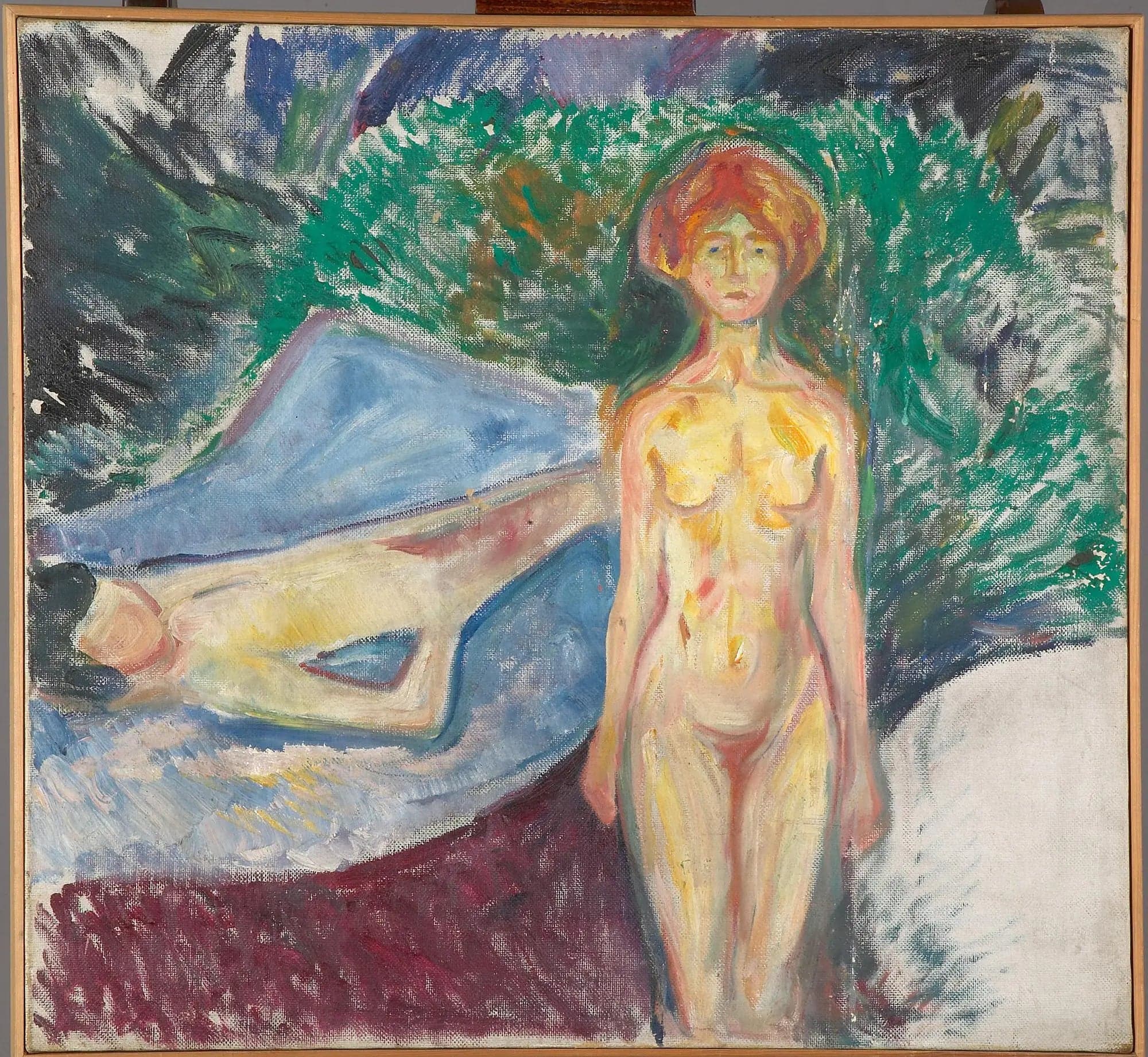
The Death of Marat
- Original dimensions
- 76 x 70.5 cm
- Museum
- Munch Museum
- Year
- 1906
Scene depicted
This painting illustrates a tragic moment in history, that of the murder of Jean-Paul Marat, a French revolutionary. Munch, through his unique vision, reinterprets this significant scene with emotional intensity, where suffering and sacrifice take on their full magnitude, transforming this painting into a cry of despair and a need for justice.
Historical context
Created in 1906, the iconic painting The Death of Marat is set in the historical context of Oslo, formerly Christiania, in Norway. Munch, a major representative of symbolism and post- impressionism , managed to capture an emotional essence characteristic of his time. Currently, this painting is displayed at the Munch Museum, delighting contemporary art lovers. Its size, 76 x 70.5 cm, allows for an appreciation of every poignant detail of this pictorial work.
Place in the artist's career
“The Death of Marat” represents a milestone in the career of Edvard Munch , a moment when his style became bolder and more revealing. Following previous works like “The Scream” and “The Madonna,” this painting manifests an evolution towards a deeper exploration of themes of pain and mortality, placing it in a period of artistic maturity.
Anecdote
“Life is a mystery. Through every color, every shape, I seek the echo of my soul.” These words of Edvard Munch resonate strongly as one imagines a spring morning in his studio, where each brushstroke of the canvas came to life, nurturing the deep inspiration that led to the creation of this masterpiece .