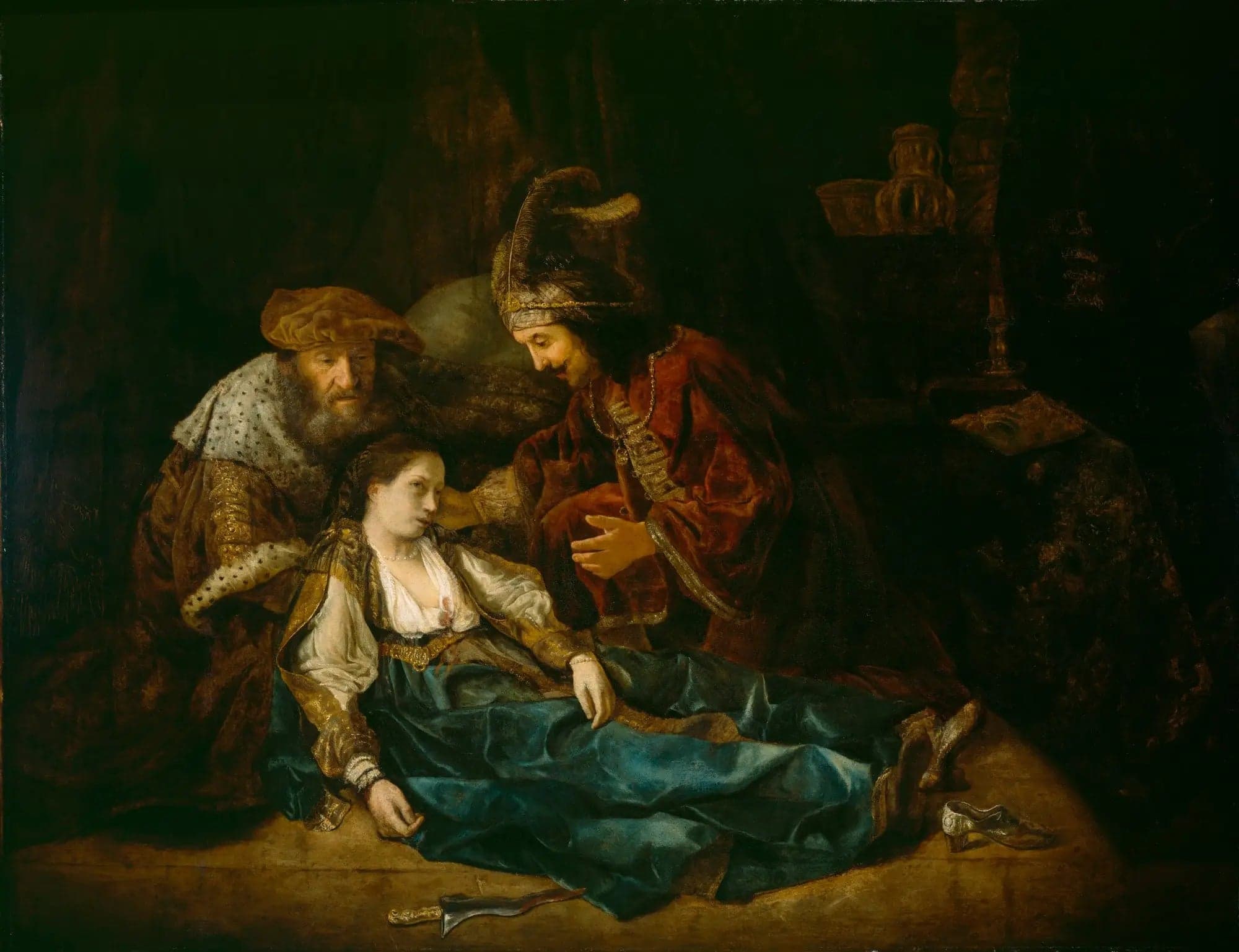
The Death of Lucretia
- Original dimensions
- 219.7 x 174 cm
- Museum
- Detroit Institute of Arts
- Year
- 1640
Scene depicted
The Death of Lucretia presents a tragic scene, that of female honor and sacrifice, where Lucretia, after being caused deep shame, makes the tragic decision to end her life. Rembrandt was able to represent this palpable tension, capturing both the despair and dignity of his heroine. The expressions of the characters are charged with intense emotion, establishing a poignant connection between the work and the viewer.
Historical context
Created in 1640, this painting masterfully immerses us in the rich culture of the 17th century, in Amsterdam, Netherlands. Rembrandt , an iconic figure of the Dutch baroque , was able to capture powerful emotions within his pictorial work. Currently on display at the Detroit Institute of Arts , this canvas impressively evokes a creative momentum in perfect synergy with History.
Place in the artist's career
The Death of Lucretia represents a turning point in Rembrandt's career, illustrating his artistic maturity. In parallel with works such as The Night Watch and The Anatomy Lesson of Dr. Tulip , one can feel here the technical evolution of the artist, from meticulous realism to more dramatic and emotional representations.
Anecdote
"Art is a reflection of the human soul," Rembrandt often said. One starry summer night, he stood in front of a window, inspired by the light filtering through the thick clouds, when he imagined the tragic force present in The Death of Lucretia . This moment of artistic awakening infused the masterpiece with all its emotional depth.