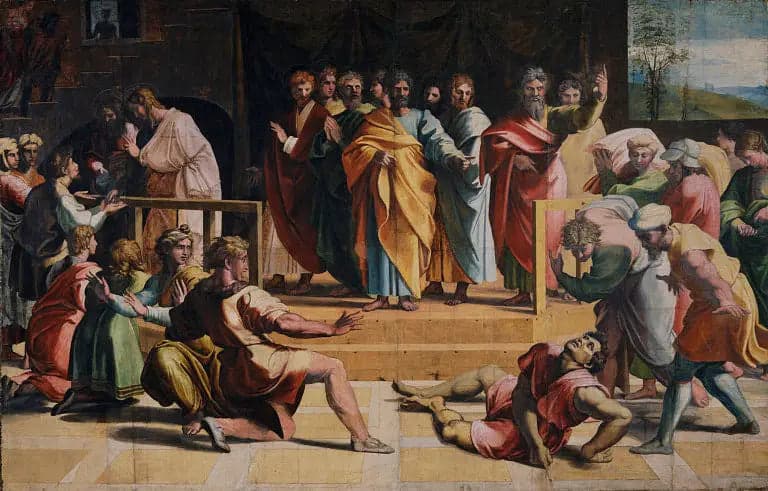
The Death of Ananias
- Original dimensions
- 440 x 385 cm
- Movement
- Italian Renaissance
- Museum
- The Raphael Cartoons
- Year
- 1515
Scene depicted
This powerful painting depicts the final moment of Ananias's life, touching on the duality of life and death. The figures gather around him, a scene where human tragedy intertwines with a spiritual dimension, thus revealing the depth of the human condition and the palpable emotion of losing a loved one. The movement of the characters gives the canvas a rare dynamic, enhancing the impact of the work.
Historical context
Created in 1515 in Italy, The Death of Ananias is part of the sumptuous era of the Italian Renaissance . This iconic painting testifies to Raphael's mastery of pictorial art through the prism of a dramatic and powerful scene, currently preserved in the museum of the Raphael Cartoons.
Place in the artist's career
The Death of Ananias is situated in a pivotal phase of Raphael's career, where he explores complex themes. Alongside works such as The School of Athens and The Sistine Madonna , this painting marks both a technical and emotional maturation, revealing his artistic evolution towards more introspective and dramatic compositions.
Anecdote
It is said that Raphael claimed: “Every painting is a poem, a story that one must live.” Imagine him, sitting in his studio, listening to the sweet whisper of the spring wind, finding inspiration in the thrill of a face encountered at the turn of an alley. This deeply personal emotion blossoms in The Death of Ananias , a reflection of his inner passions.