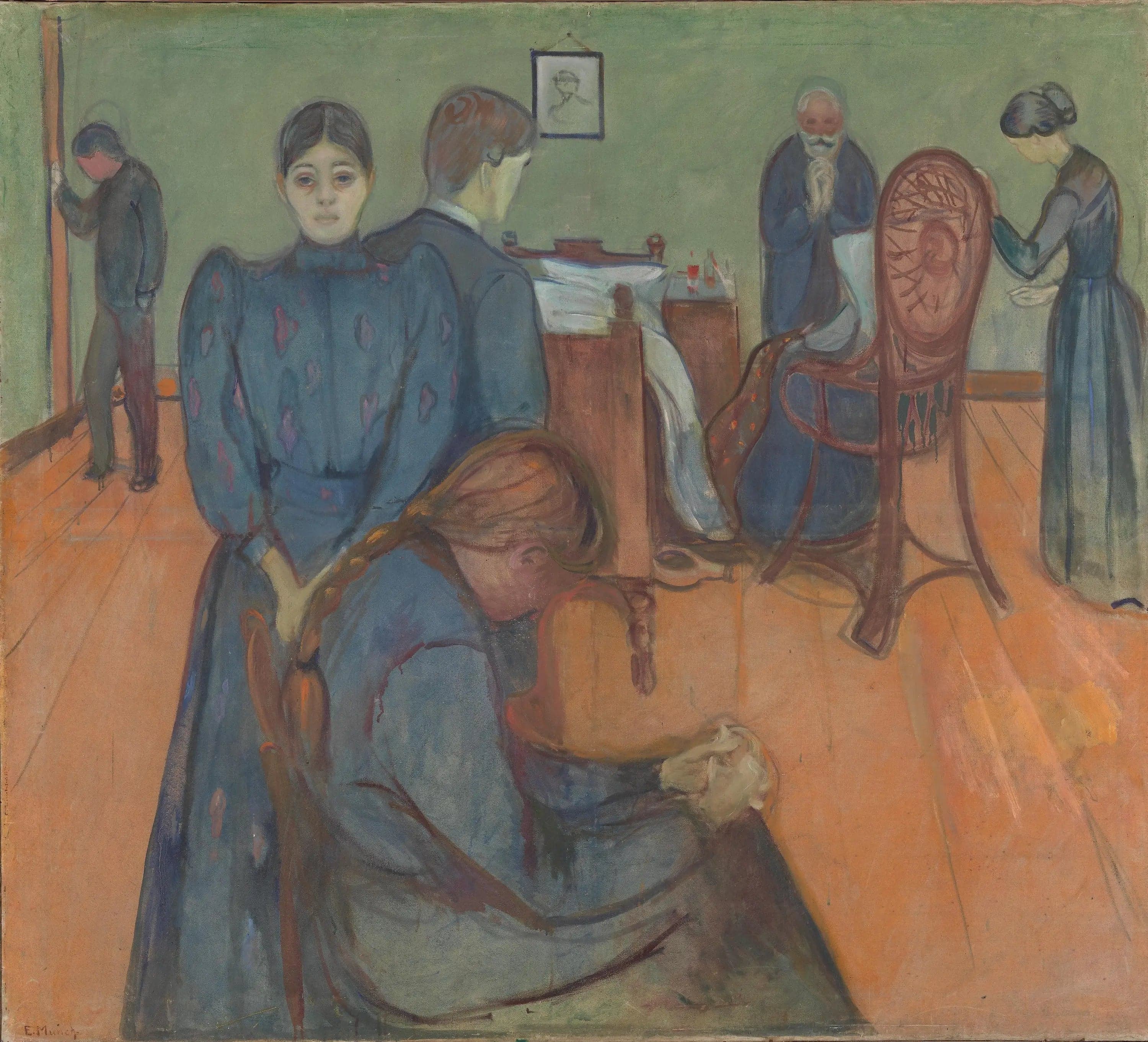
The Death in the Sick Room
- Original dimensions
- 169.5 x 152.5 cm
- Museum
- National Gallery of Oslo
- Year
- 1893
Scene depicted
The canvas depicts the figure of death watching over a sick person, whose shadow is cast on the wall, amplifying the atmosphere of anxiety and sadness. This scene illustrates the fragility of life, embodied by the intangible presence of death. Munch succeeds in translating this duality between hope and despair, creating a painting that resonates deeply with each of us.
Historical context
Created in 1893 in Oslo, this painting is emblematic of the symbolist movement. Edvard Munch , influenced by his personal experiences and the culture of his time, captures a poignant scene where the face of death becomes a stage actor in a disturbing intimacy. Today, this canvas rests in the National Gallery of Oslo, a space dedicated to artistic expression and reflection on the human condition.
Place in the artist's career
The Death in the Sickroom represents a turning point in Munch's career, marking his entry into artistic maturity. Compared to other works like The Scream and Existentialism, this canvas reveals an evolution of emotions, moving from despair to a more tranquil understanding of mortality.
Anecdote
“The inspiration came to me one evening, sitting by my mother's bedside, watching the light play on the walls, as if death itself had breathed.” These words from Munch highlight the emotional intensity behind this masterpiece . A suspended moment, captured in the painting , evokes both pain and acceptance.
Major exhibitions
Olaf Schous gave to the National Gallery: National Gallery November 14, 1987 - February 7, 1988