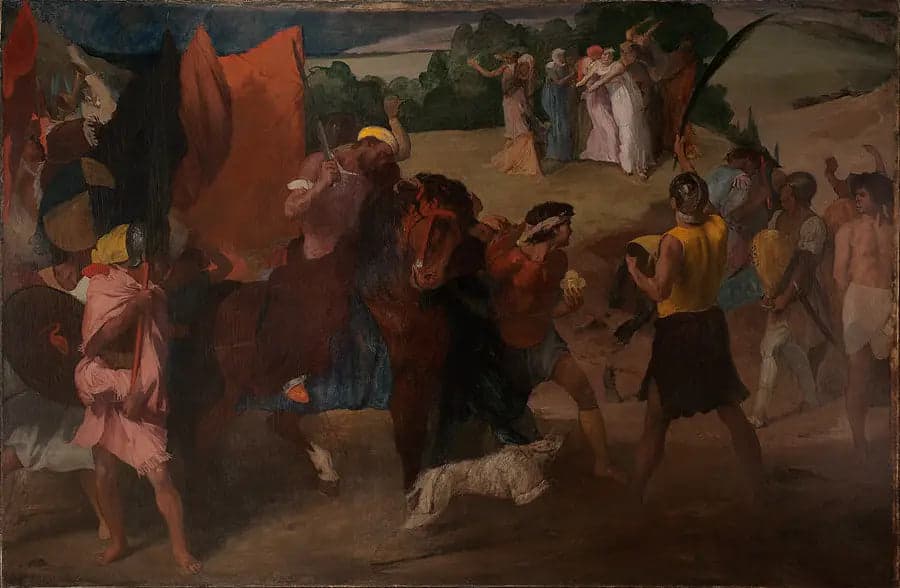
The Daughter of Jephthah
- Original dimensions
- 298.5 x 195.5 cm
- Museum
- Smith College Museum of Art
- Year
- 1859
Scene depicted
This painting evokes the tragic biblical tale of Jephthah, who, after a victory, realizes that his daughter must be sacrificed as a vow. Degas, with poignant depth, captures a moment before this sacrifice, encapsulating the tension and innocence of a threatened youth. At the center of the scene, the daughter, a symbol of vulnerability, stands in contrast to the heavy burdens of expectations and sacrifices.
Historical context
Created in 1859 in Paris, The Daughter of Jephthah is part of the realistic movement, which was in full artistic effervescence. This canvas embodies the desire to capture deep emotions through everyday scenes. Currently housed at the Smith College Museum of Art , this large painting , measuring 298.5 by 195.5 cm, conveys a story imbued with suffering and introspection, while echoing the existential quest of the artist.
Place in the artist's career
The Daughter of Jephthah marks a significant milestone in Degas's career, situated at the crossroads between his promising beginnings and his period of maturity. Compared to paintings such as The Dancer, where the art of movement is central, or The Ballet Scene, the masterpiece reveals an evolution towards a more pronounced emotional introspection, while retaining its unique signature in staging.
Anecdote
“I always seek to express what I feel through my pictorial works ,” Degas is said to have remarked. The creation of The Daughter of Jephthah was born one April morning, when the sun played with shadows in his Montmartre home. This fleeting moment, merging light and melancholy, breathed new life into this painting , a true echo of human drama.