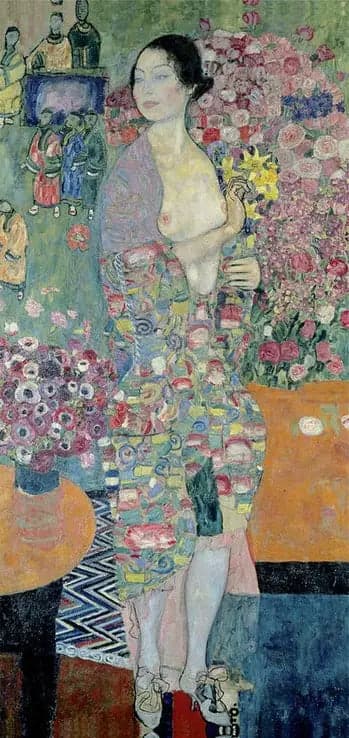
The Dancer
Scene depicted
“The Dancer - Gustav Klimt ” depicts a woman in full motion, her body undulating to the rhythm of enchanting music. The draping of her colorful dress, like a floral pattern, harmoniously merges with the golden bursts of the background, creating a space that is both intimate and festive. It is a celebration of femininity and the art of movement, capturing a moment of lightness and ecstasy.
Historical context
Created in 1910 in Vienna, Austria, this painting is emblematic of the symbolist movement and the Viennese Secession , which revolutionized art in the early 20th century. Within this movement, Gustav Klimt captured human emotion through sinuous lines and vibrant colors. Today, the painting is preserved in the prestigious permanent collection of the Belvedere in Vienna. Its majestic dimensions, 150 x 120 cm, give it an unparalleled visual impact.
Place in the artist's career
This painting occupies a central place in Klimt's career, symbolizing his period of artistic maturity. At this time, the artist achieved a perfect synthesis between sensuality and ornamentation. Compared to “ The Kiss ” and “ The Woman in Gold ”, “The Dancer” illustrates a marked technical evolution characterized by increasingly bold compositions, integrating elements of mosaic and decorative art.
Anecdote
“Life is like a dance, each movement tells a story.” This quote perfectly summarizes Klimt's creative spirit. Inspired by the dances of the grand Viennese winter ball, he delighted in immortalizing the grace of a female figure through a vibrant spring, where each brushstroke evokes the sweet scent of blooming flowers.