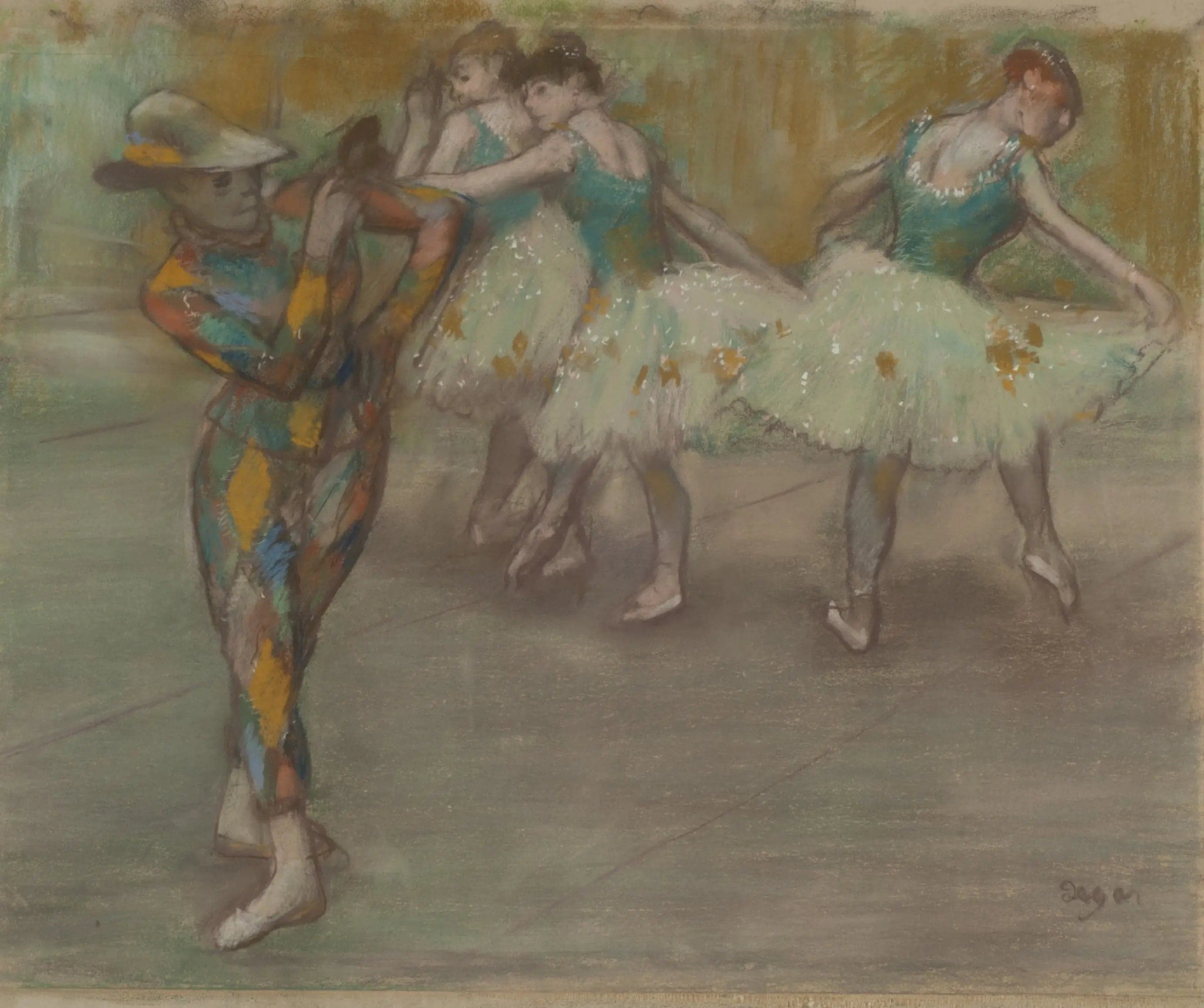
The Dance of Harlequin
- Original dimensions
- 63 x 52 cm
- Museum
- National Museum of Fine Arts Buenos Aires
- Year
- 1890
Scene depicted
The painting "The Dance of Harlequin" illustrates a young dancer executing graceful steps in an intimate space of a theater, where shadows and lights intertwine. The dynamic composition, where the artist manages to capture the effervescence of movements, invites the viewer to enter the vibrant world of the spectacle, where each gesture becomes an improvised note of music.
Historical context
Created in 1890 in the city of Paris, The Dance of Harlequin is at the heart of the Impressionist movement, which breaks artistic conventions to capture movement and light. At that time, Paris is a nerve center of creativity, where art evolves rapidly, shaped by the desire for experimentation and novelty. This canvas , currently exhibited at the National Museum of Fine Arts in Buenos Aires, testifies to Degas's boldness, master of the representation of movement.
Place in the artist's career
This painting delicately positions itself at the peak of Degas's career, a current time of artistic maturity, where he juggles with forms and colors. In parallel with his other iconic works like "The Dance Class" and "Dancer in Green," this creation demonstrates the evolution of his style, moving from realistic capture to a more emotional and abstract interpretation.
Anecdote
Edgar Degas is said to have remarked: "Dance is poetry on two feet." This sentiment guided him in the creation of this painting , inspired by the backstage of a ballet, where he was captivated by the elegance of the dancers and the palpable energy of a stolen moment. This fleeting moment, charged with emotion, vibrates through every brushstroke of the painting .