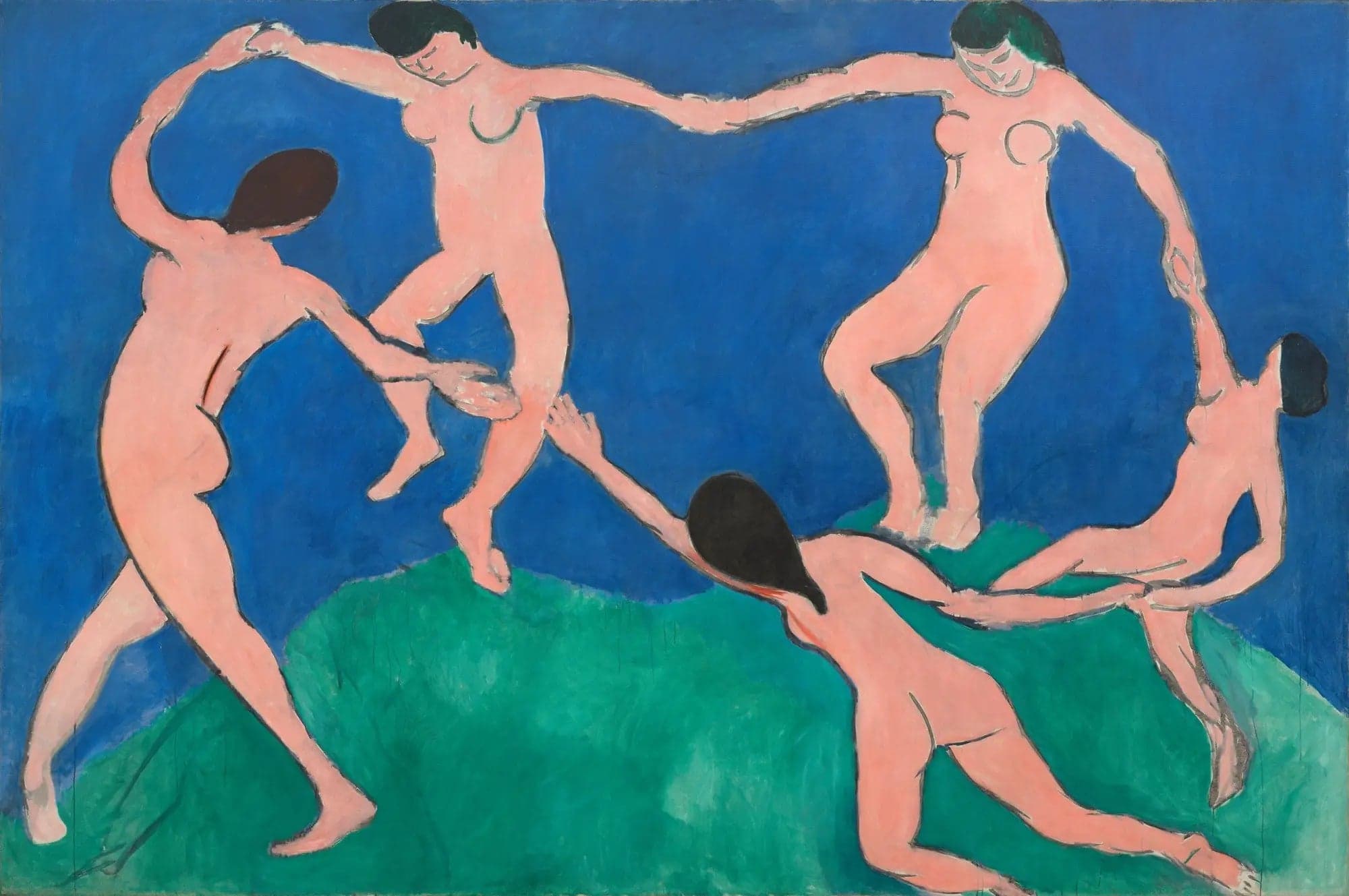
The Dance I
- Original dimensions
- 390.1 x 102.5 cm
- Movement
- fauvism
- Museum
- Museum of Modern Art
- Year
- 1909
Scene depicted
In this pictorial work, Matisse captures a striking moment where characters move to a dance circle, a lively expression of human conviviality. The bodies intertwine to the rhythm of an invisible melody, transcending time and space. The composition, vibrant with bright colors and simple shapes, evokes a joyful, free, and unrestrained world, reflecting the essence of dance.
Historical context
Created in 1909 in the vibrant city of Paris , this painting is emblematic of a major step in the evolution of the fauvist movement . At that time, Matisse, a leading figure of this artistic current, drew his inspiration from the beauty of nature and human relationships. The painting, now displayed at the famous Museum of Modern Art , offers us a striking view of the dynamics of dance and harmony, through its monumental dimensions.
Place in the artist's career
The Dance I is at the heart of Matisse's career, marking a turn towards bolder abstraction. This painting juxtaposes with works such as The Woman with the Hat and Odalisque , where the artist explores color and form in an increasingly liberated manner. The Dance I is a culmination of his quest for pure expression, revealing the maturity of his artistic vision.
Anecdote
Henri Matisse said: "A painting must be linked to happiness and joy." It was probably on a sunny spring morning that the artist found inspiration for The Dance I , observing dancers moving gracefully. This scene of joy immortalized in the canvas expresses a moment of pure euphoria, connecting the artist to the very essence of existence.