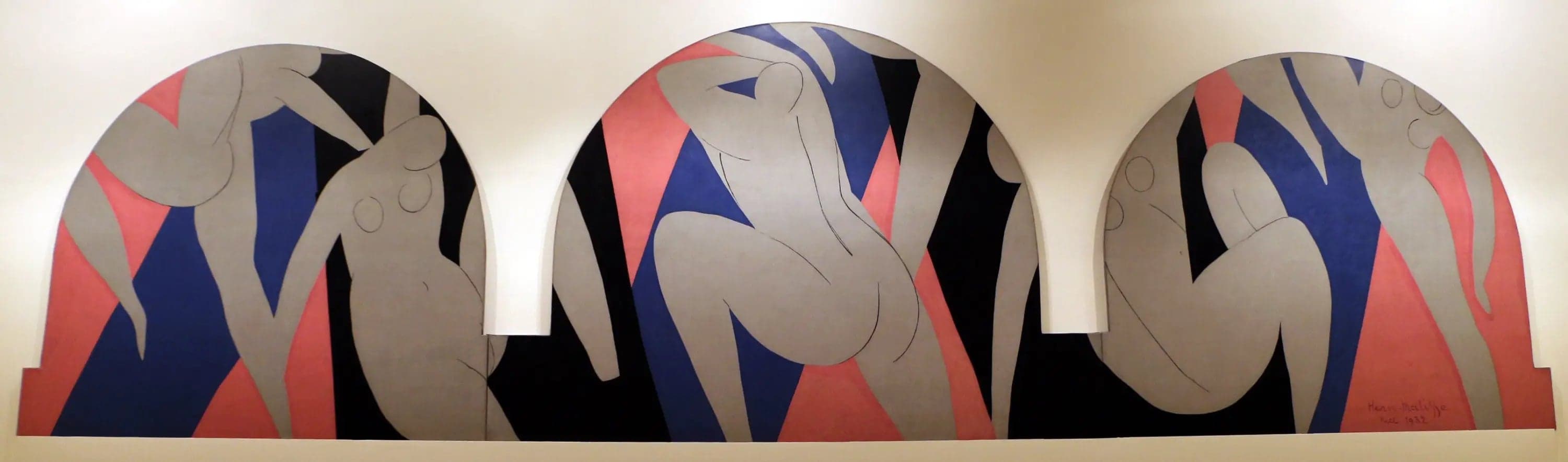
The Dance
- Original dimensions
- 1271 x 355 cm
- Museum
- Palais de Tokyo
- Year
- 1933
Scene depicted
This famous painting evokes the celebration of life through movement and dance. Stylized and intertwined human figures hold hands, forming a fantastic circle that breathes joy and communion. The silhouettes, stripped of superfluous details, seem to float in a space of harmony where vibrant colors transcend reality. The Dance is an emblematic work that transcends time, inviting the viewer to feel the dynamics and joy of life that animate it.
Historical context
Created in 1933 in Nice, The Dance is at the heart of the modern period, emblematic of Fauvism , a bold and colorful artistic movement. The canvas, now preserved at the Palais de Tokyo, is a beacon of expressionism in art. Its monumental size reflects Matisse's desire to capture the vital energy of the dancers in an explosion of color and form. This work is the result of an era marked by cultural dynamism and artistic effervescence on the Côte d'Azur.
Place in the artist's career
The Dance represents a pivotal moment in Matisse's career, marking the peak of his formal explorations and visual commitment. The artist, already recognized for works like The Woman with the Hat and The Wedding of Pierrette , showcases here his mastery of forms and colors. This painting is the culmination of an artistic quest that redefined modern painting.
Anecdote
Henri Matisse once stated: "Painting is a way of life, not just a reflection of reality." It was in a sunny alley in Nice, accompanied by the floral scents of spring, that he was inspired by the rhythm of dance, bodies in motion, and the freedom of expression. This fleeting moment served as the foundation for the vibrant emotion present in The Dance .