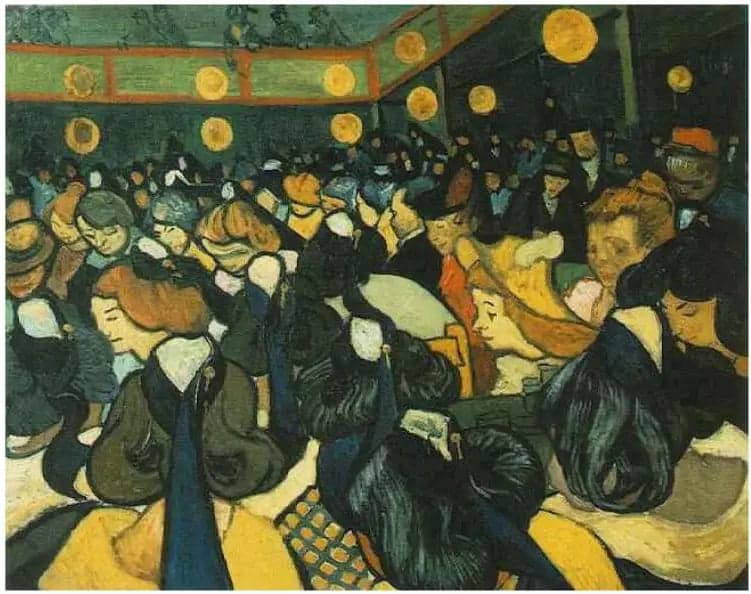
The Dance Hall in Arles
Scene depicted
In the painting The Dance Hall in Arles , van Gogh immerses us in a festive atmosphere rich in colors. He depicts a hall coming alive with movement and joy, each character engaged in dance, as if suspended between shadow and light. This pictorial work is a vibrant tribute to the culture and conviviality of social life at the time.
Historical context
Written in 1888, the painting The Dance Hall in Arles is the result of the creative genius of Vincent van Gogh , conceived in the beautiful city of Arles , in the heart of the Provence region. This canvas is emblematic of the artistic movement known as cloisonnism, a unique approach that van Gogh masters brilliantly. Today, this work is preserved at the Orsay Museum in Paris , measuring 810 x 650 cm.
Place in the artist's career
The Dance Hall in Arles represents a crucial step in the artistic journey of Vincent van Gogh . While he was already standing out with paintings such as Sunflowers or The Starry Night , this canvas reveals his incredible mastery of colors and emotions, marking a stylistic peak in his career.
Anecdote
“Painting is my refuge, my way of speaking to the world” van Gogh might have declared, as he observed life in the sunny city of Arles . This moment of clarity, at the turn of a bustling alley one morning, inspired him to create this vibrant painting , capturing the joy and energy that animated the dancers. This canvas evokes the echoes of laughter and the softness of the dim lights dancing on the walls.