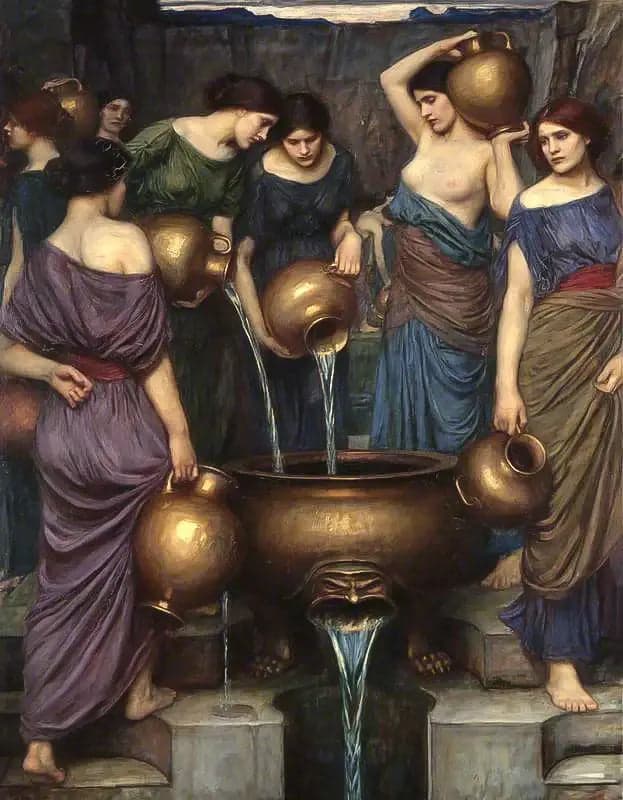
The Danaids
Scene depicted
The painting “The Danaïdes” depicts the fifty daughters of the king of Egypt, condemned to fill a bottomless sieve as punishment. Amid this mythological drama, Waterhouse portrays an atmosphere laden with melancholy, where each face expresses both despair and beauty, revealing the internal struggles of the protagonists.
Historical context
Created in 1903, this iconic work is the result of the genius of John William Waterhouse , a British painter based in London. Representing the Pre-Raphaelite movement, the work is set in a period where mythology and nature are intimately linked. The original painting is currently displayed at the Manchester Art Gallery, in the United Kingdom, measuring 183 cm by 122 cm.
Place in the artist's career
“The Danaïdes” is situated at a pivotal moment in Waterhouse's career, reflecting his artistic mastery. Alongside “The Donkey of Tentino” and “The Cycle of Life,” this painting illustrates an evolution towards a deeper representation of light and emotion, while maintaining a strong grounding in the mythological.
Anecdote
Waterhouse once declared: “True beauty hides in pain and passion.” Imagine him, sitting in front of his easel one spring morning, light filtering through the leaves of a tree, inspired by the tragic strength of ancient myths. This vision nourishes the emotional power of The Danaïdes .