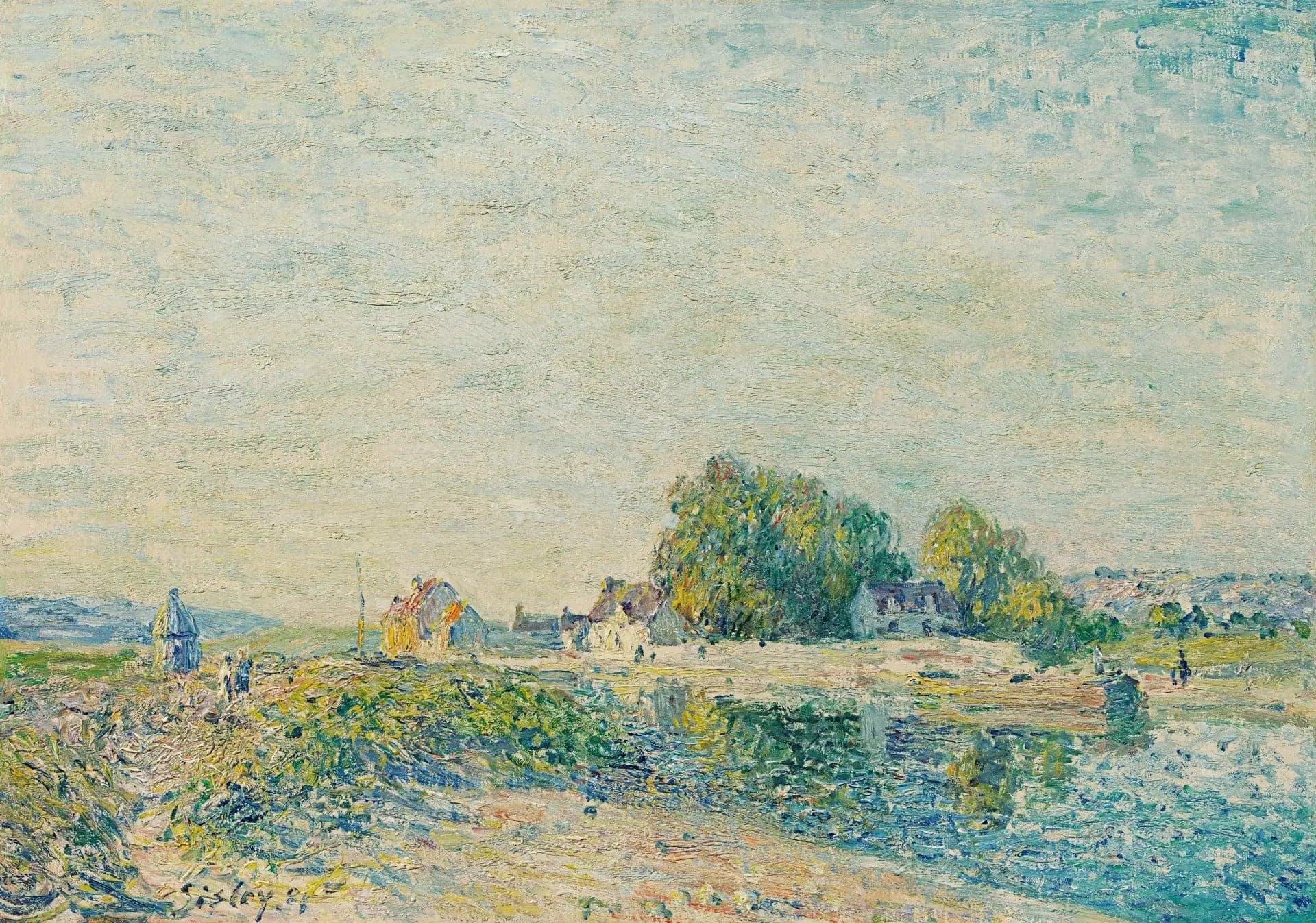
The dam of the Loing canal in Saint-Mammès
- Original dimensions
- 54.6 x 38.7 cm
- Museum
- Richard Green Fine Paintings
- Year
- 1884
Scene depicted
In this composition, the painting depicts a delicate scene where the dam and nature interact in harmony. Flanked by majestic trees, the tranquility of the canal invites contemplation. The reflections in the water play with the light, creating an immersive atmosphere where the viewer can almost hear the splashing of the water and feel the gentle breeze on their face. It is an invitation to dive into a suspended moment, a living painting where every color and every shape are witnesses to a reality full of charm.
Historical context
This painting, created in 1884, is a masterpiece of the Impressionist movement, representing a moment frozen along the canal of Loing in the charming town of Saint-Mammès. At that time, France was on the brink of an artistic revolution, marked by a quest for authenticity and light. Currently, this pictorial work is exhibited at the Richard Green Fine Paintings museum, where it attracts the gaze and hearts of visitors. Its dimensions testify to the scale of this creation, perfectly proportioned to capture every subtlety of the landscape.
Place in the artist's career
The dam of the canal of Loing in Saint-Mammès is situated at a crucial turning point in Alfred Sisley's career. After previous works, he reaches a stylistic maturity here. Compared to "The Seine at Argenteuil" and "The River", this painting represents an evolution towards more intimate atmospheres and an even more fascinating luminosity. Sisley was able to capture the magic of an ordinary moment, magnifying the beauty of the French landscape while revealing his exceptional craftsmanship.
Anecdote
“Light speaks to us, it reveals the gentle whisper of nature.” This is how Alfred Sisley might evoke the inspiration behind his painting. Imagine a spring morning, where the murmur of the canal water mingles with the songs of birds. It is in this moment of serenity that the artist captured the very essence of nature, translating every nuance into his iconic pictorial work.