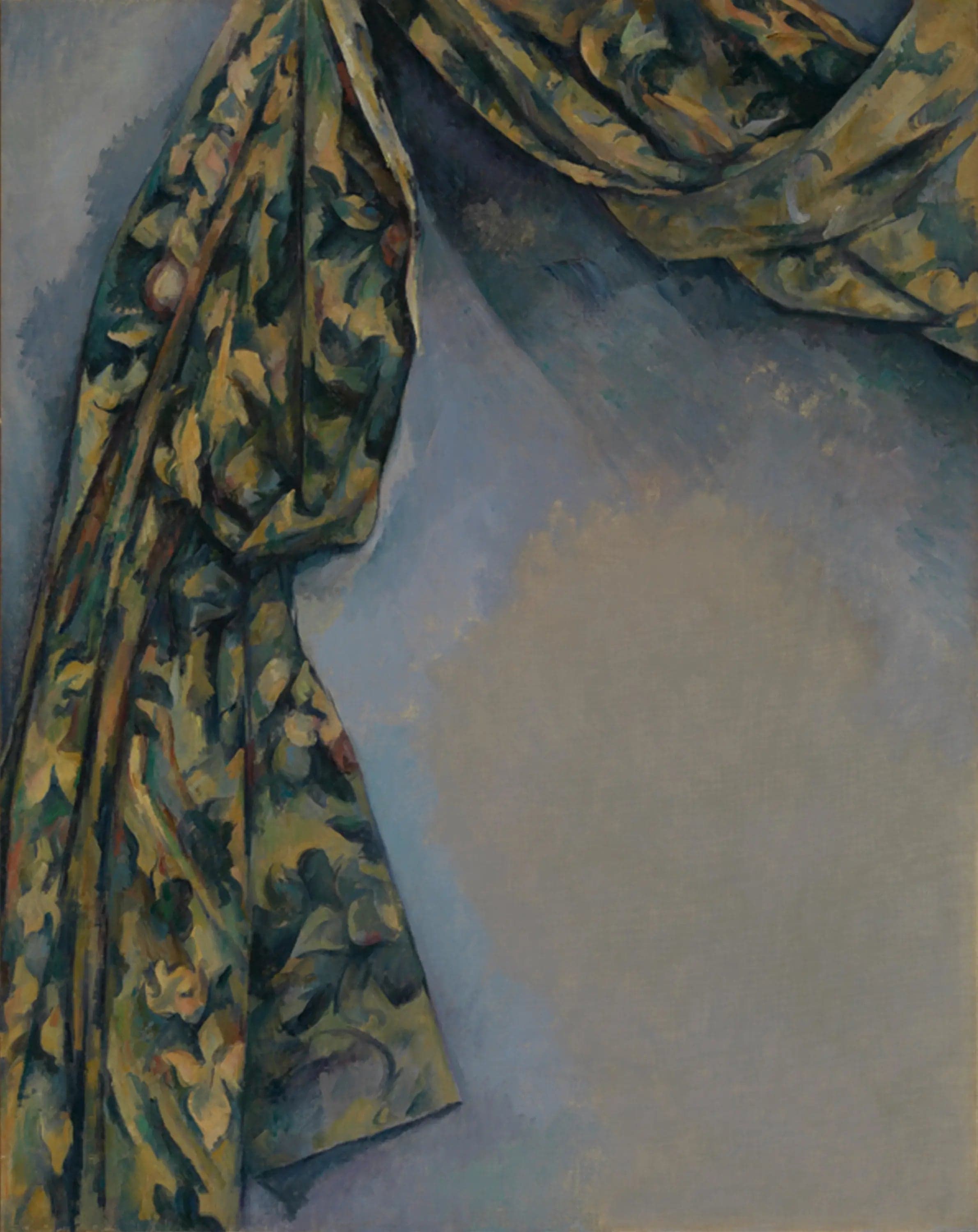
The Curtain
- Original dimensions
- 72 x 92 cm
- Museum
- Abegg Foundation
- Year
- 1889
Scene depicted
In this canvas , Cézanne immerses us in an intimate atmosphere where a beautifully draped curtain creates a separation between the inside and the outside. The filtering light plays on the rich textures, while animating the background with a mysterious depth. This contrast embodies the tensions between the visible world and the invisible, thus illustrating the duality dear to the artist.
Historical context
Created in 1889, this painting is emblematic of the peak of the Impressionist movement, in the serene city of Aix-en-Provence, the cradle of modern art. At that time, Cézanne, an iconic figure of Impressionism , sought to explore light and color with unprecedented depth. Today, this canvas can be admired at the Abegg Foundation, a showcase for art where it reveals all its splendor.
Place in the artist's career
The Curtain represents a transition in Cézanne's career, marking his period of maturity, where he redefines shapes and volumes. At that time, he also produced other masterpieces, such as “The Montagne Sainte-Victoire” and “The Large Bathers,” highlighting his evolution towards a more abstract and bold pictorial language.
Anecdote
“A work of art is a way to immortalize an emotion. I paint reality as I feel it.” These words from Cézanne reveal the artist's introspection, inspired by a sunny morning where the light gently caressed the curtain, through which he glimpsed the secrets of a world vibrant with colors. This moment of wonder is the source of the evocative power of this painting .