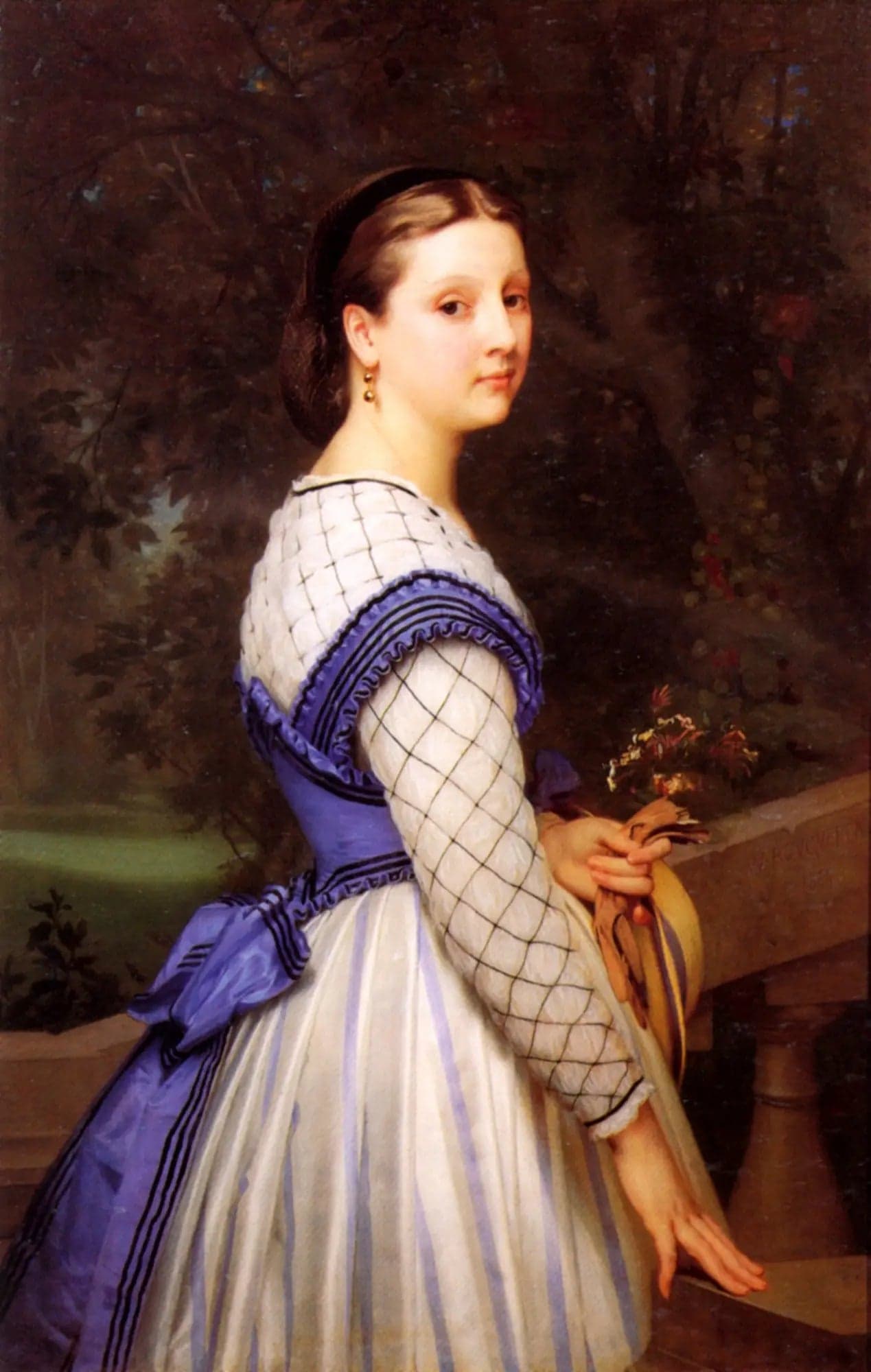
The Countess of Montholon
- Original dimensions
- 76 x 112 cm
- Movement
- Academicism
- Museum
- Murauchi Art Museum
- Year
- 1864
Scene depicted
In this painting, Bouguereau depicts the Countess of Montholon with unparalleled delicacy. Her serene and majestic pose, the blooming white roses emanating from her surroundings, testify to a refined elegance. The introspective gaze of the Countess invites the viewer on a sentimental journey, revealing the feelings of this bourgeois and feminine era, full of grace and nobility.
Historical context
Created in 1864 in the elegant and refined setting of Paris, this painting by Bouguereau is part of the academic movement, characterized by a virtuous quest for beauty. The painting, currently displayed at the Murauchi Art Museum, offers a window into a time when art sought to capture the true human essence through the finesse of its features and the delicacy of its colors.
Place in the artist's career
This painting stands as a centerpiece in Bouguereau's career, representing the pinnacle of his academic style. As remarkable as The Nymph of the Spring and The Washerwomen , these paintings illustrate his evolution as an artist, where each canvas explores human beauty with precision and tenderness.
Anecdote
“The greatness of art lies in the subtleties of a gaze,” Bouguereau once declared. That morning, as he admired the golden light filtering through the trees in the garden of his home, he imagined the silhouette of an aristocrat, embodied here by the Countess, paying homage to the timeless beauty of nature and beings. This moment of wonder gave birth to a pictorial work imbued with emotion.