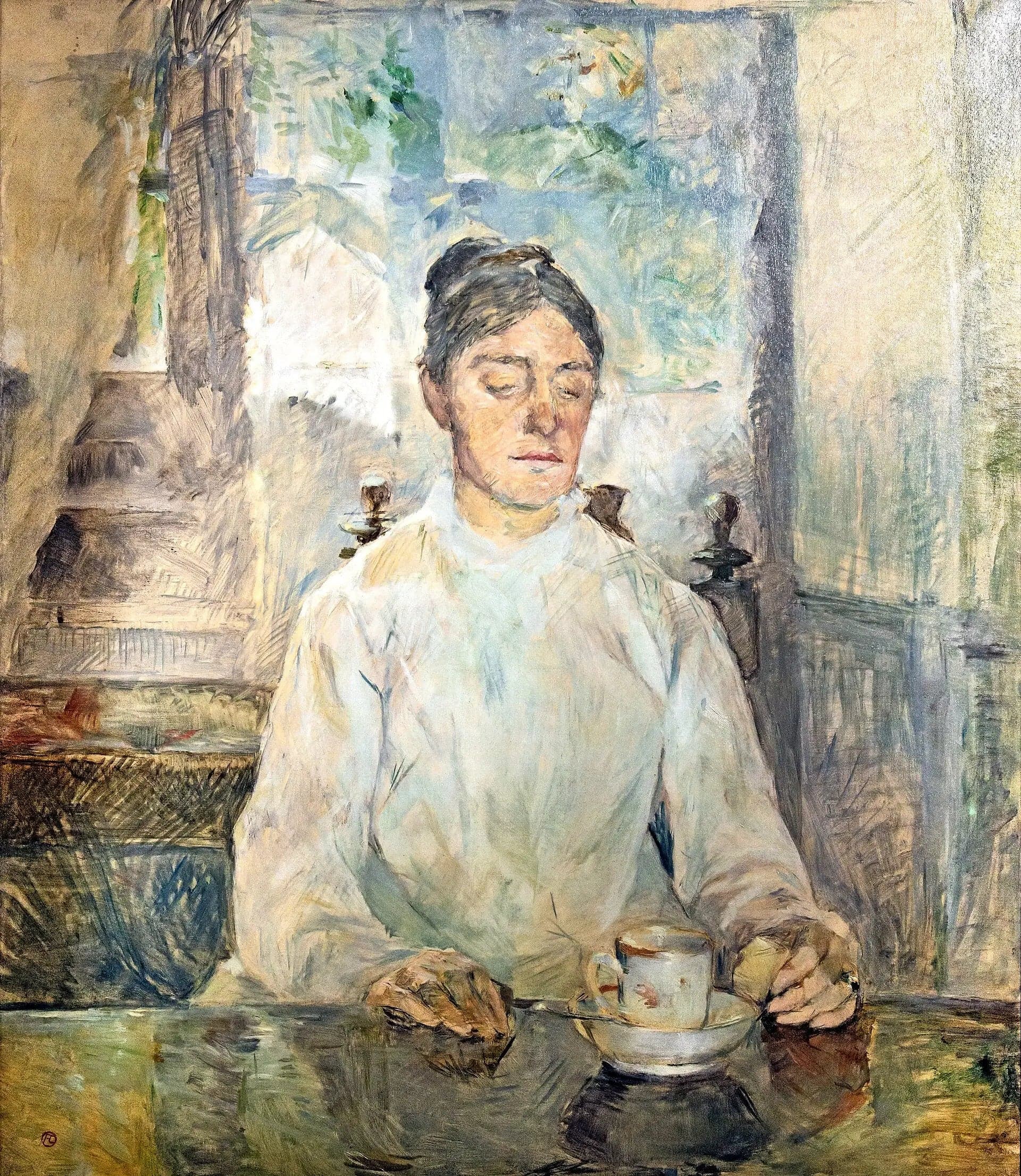
The Countess Adèle by Toulouse-Lautrec - Henri de Toulouse
- Original dimensions
- 81 x 93 cm
- Museum
- Toulouse-Lautrec Museum
- Year
- 1883
Scene depicted
This canvas , portraits of an ethereal beauty, depicts Countess Adèle among her contemporaries, illustrating not only an aristocratic character but also a captivating atmosphere filled with whispered conversations and delicate laughter. The rich fabrics and intricate details give the work a splendor that transports the viewer into the backstage of Parisian high society.
Historical context
Created in 1883, this painting embodies its roots in the Parisian capital, a witness to an era marked by the post-impressionist movement. In a setting where the Belle Époque flourishes, Toulouse-Lautrec captures the essence of aristocratic life through an authentic and evocative style. Today, the canvas resides in the Toulouse-Lautrec Museum, keeping the memory of its creator alive in Albi.
Place in the artist's career
The Countess Adèle stands as a significant milestone in Toulouse-Lautrec's journey, an artist whose career rises with compositions like “Le Moulin Rouge” and “Yvette Guilbert.” This work represents a period where the artist refines his style, marking a turning point between intimate portraits and vibrant cabaret scenes.
Anecdote
Henri de Toulouse-Lautrec once stated: “Life is a dance that each brush translates in its own way.” It is in this quest for expression that the canvas of The Countess Adèle is born, inspired by a peaceful afternoon, where the soft light caressed the faces of high society members. This fleeting moment transformed into a pictorial work of rare emotional depth, echoing a timeless elegance.