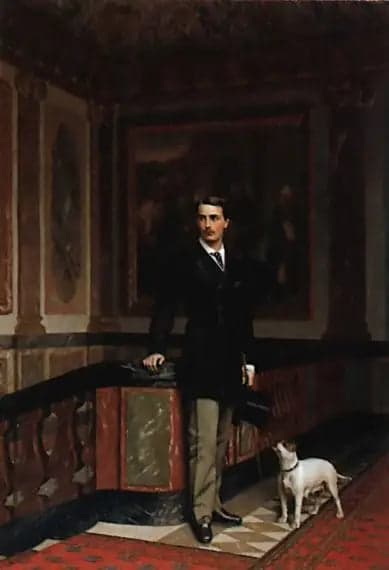
The Count of La Rochefoucauld and Duke of Doudeauville - Jean
- Original dimensions
- 36.2 x 50.8 cm
- Movement
- academicism
- Museum
- Not specified
- Year
- 1850
Scene depicted
The painting “The Count of La Rochefoucauld and Duke of Doudeauville” represents a vibrant portrait of a man of influence, expressing both the power and delicacy of 19th-century nobility. Through this painting , Gérôme invites us to explore the subtleties of aristocratic attitudes, precisely capturing the distinctive features and sumptuous clothing of his model.
Historical context
This painting , created in 1850, finds its origin in a Parisian context where academicism shone as an artistic movement, reflecting the refined taste of the time. The work has since toured salons and stands out for its boldness and elegance. Although currently unknown in a specific museum, it remains an painting emblematic of the aspirations of a culture in full cultural turning point.
Place in the artist's career
This pictorial work positions itself in Gérôme's career as an essential milestone, illustrating his evolution towards a more assertive and confident style. At the same time, it can be studied alongside other paintings such as “The Dance of Life” and “Pollice verso,” revealing how the artist played with themes of spectacle and portrait in search of a perfect aesthetic.
Anecdote
“Beauty lies in the truth of expression.” These words of Gérôme come to mind when observing the composition of the masterpiece , whose inspiration undoubtedly sprang forth on a sunny morning in a light-filled studio. The painting captures the very essence of the character, emanating an emotional depth that transports the viewer to another time.