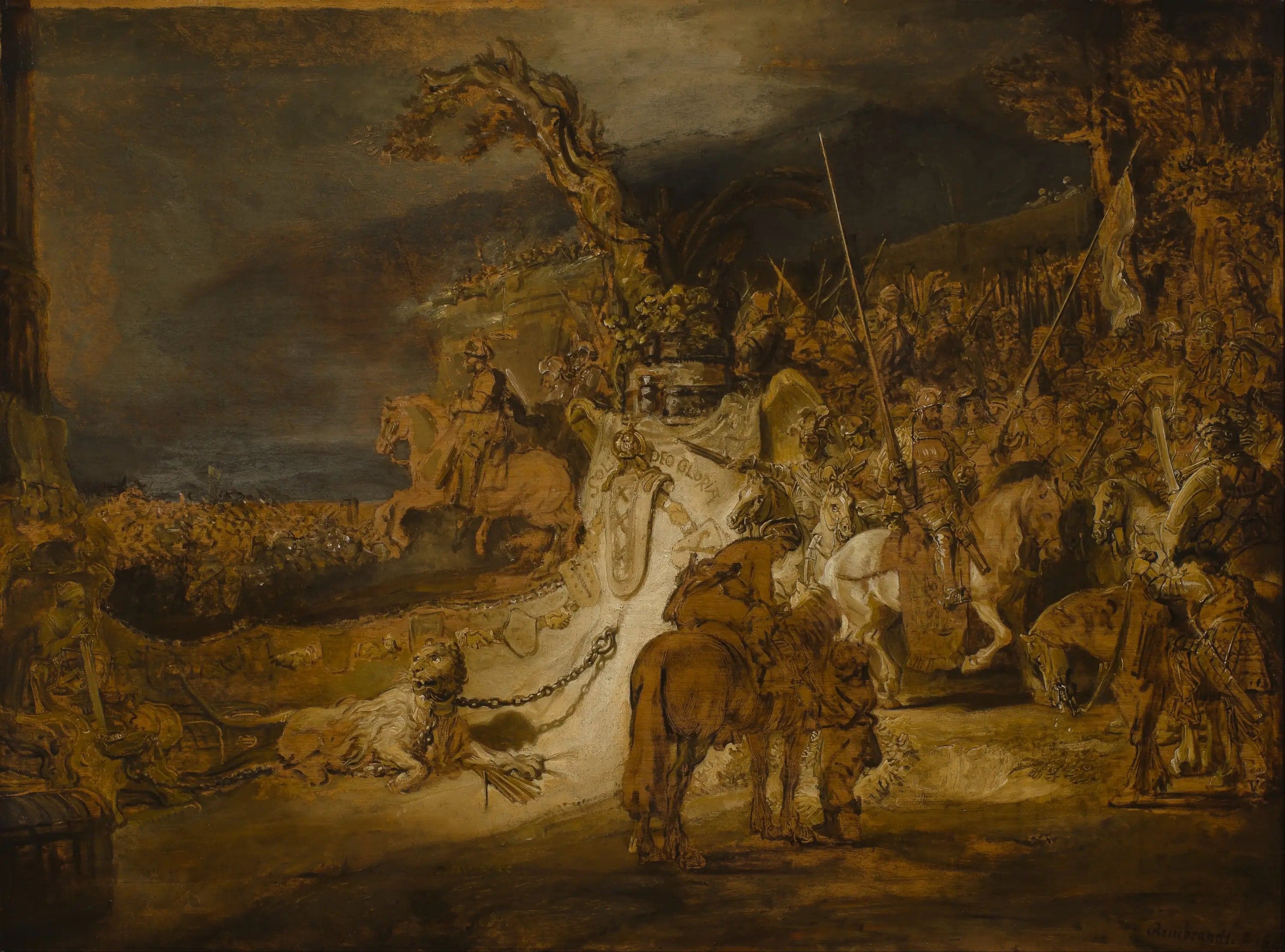
The Concord of the State
- Original dimensions
- 101 x 74.6 cm
- Movement
- Dutch Golden Age of Painting
- Museum
- Boijmans Van Beuningen Museum
- Year
- 1642
Scene depicted
This painting is a celebration of unity and peace, bringing together influential figures of Amsterdam during a symbolic assembly. Each character, though motionless, conveys a dynamic of interaction, hinting at the tensions and aspirations of society at the time. The composition by Rembrandt evokes the search for harmony at a time when conflicts were omnipresent, illuminating both despair and the hope for unity.
Historical context
The canvas emblematic of The Concord of the State was created in 1642, in the heart of Amsterdam, a city where the discerning eye can feel the vibrant pulse of the Dutch Golden Age of Painting. This work fascinates with its historical context, reflecting the political and social struggles of the time. It is currently displayed at the Boijmans Van Beuningen Museum , a place where every visitor can immerse themselves in the Dutch cultural heritage, in a soft light filtered through the ancient windows.
Place in the artist's career
The Concord of the State represents a crucial point in Rembrandt's career, marking his stylistic maturity and acute sense of pictorial storytelling. Alongside the painting The Night Watch , which reveals a form of energy and movement, and The Anatomy Lesson of Dr. Tulp , which exposes it from a clinical and detailed angle, this work reveals the evolution of his approach to light and oil, concurrent with the exploration of human emotions.
Anecdote
Rembrandt is said to have remarked: “Every painting is a reflection of the artist's soul, a window into their universe.” Far from the tumult of the world, one April morning, he was inspired by a gentle ray of light that caressed his studio. This fleeting moment infused the magic of The Concord of the State , revealing an emotional power in every brushstroke.