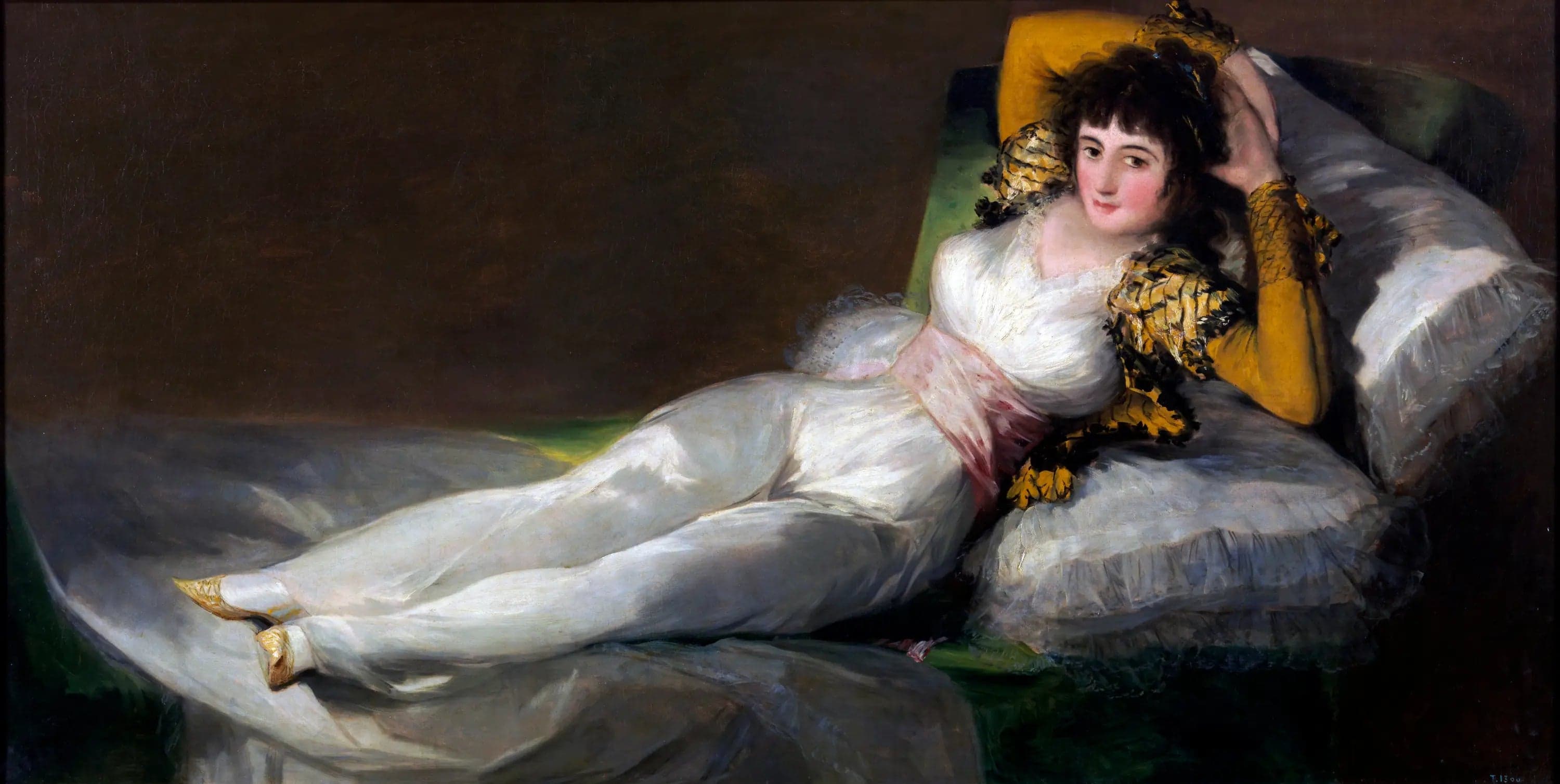
The Clothed Maja
- Original dimensions
- 190 x 95 cm
- Museum
- Prado Museum
- Year
- 1800
Scene depicted
In this canvas , Goya depicts a woman dazzling with beauty, wearing a refined dress that highlights her curves and radiant state of mind. The direct gaze of the Maja draws the observer in, while offering a hint of mystery, an invitation to enter her world. This pictorial work is not just a portrait, but a statement on beauty and female emancipation.
Historical context
Created in the early 19th century, this painting is emblematic of the stylistic transition between baroque and romanticism . Made in Madrid, Spain, it is set against the tumultuous backdrop of a country undergoing political and social change. Today, this canvas is housed in the prestigious Prado Museum, where it is celebrated for its emotional power and bold composition.
Place in the artist's career
La Maja vêtue stands in Goya's career as a symbol of his creative boldness and deep commitment to the representation of human nature. This painting, alongside La Maja nue and the Executions of May 3rd, marks a period of artistic maturity, highlighting his technical and emotional evolution towards a more personal and expressionist style.
Anecdote
“Beauty must be laid bare,” Goya is said to have declared, referring to the moment of inspiration for this masterpiece . Imagine a spring morning, the air fragrant with flowers, where light gently falls on a face encountered in the street, a vision that inspired him with the strength and sensuality of the painting .