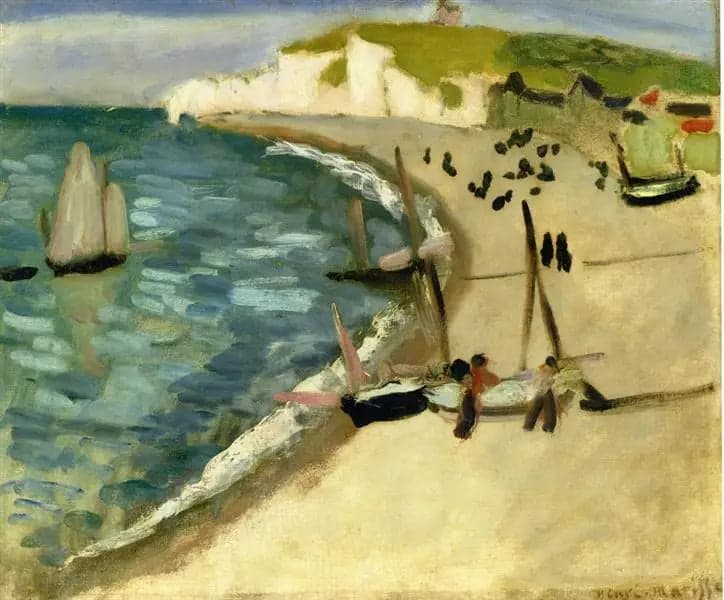
The Cliffs at Étretat
- Original dimensions
- 46 x 38 cm
- Museum
- Uehara Museum of Modern Art
- Year
- 1920
Scene depicted
The painting “The Cliffs at Étretat” represents a dazzling view of these iconic rock formations, with the sublime lighting that the morning sun bestows upon the landscape. The fusion between sky and sea becomes a spectacle, the horizon embracing the sea in a deep blue, while the cliffs, steep and majestic, rise as a symbol of the imposing beauty of nature. Each brushstroke celebrates light and shadow, revealing the dynamics of this exceptional coastal scene.
Historical context
Created in 1920, this painting is situated in the prestigious artistic tradition of the 20th century. It draws inspiration from the majesty of the Normandy coast, more specifically in the town of Étretat, known for its breathtaking landscapes. At the crossroads of Fauvism and modernism, this canvas illustrates Matisse's desire to break free from conventions while celebrating nature. The present canvas is currently exhibited at the Uehara Museum of Modern Art, where it attracts admirers of valuable pictorial works.
Place in the artist's career
This painting stands as a crucial milestone in Matisse's evolution. After his first success with “The Dance,” this period marks a stylized peak where color reigns supreme. Coupled with works such as “The Joy of Life” and “Woman with a Hat,” “The Cliffs at Étretat” shows us how he pushed the boundaries of perception, using vibrant palettes to express tangible emotions beyond mere realism.
Anecdote
“I paint colors, not objects.” Henri Matisse often spoke of his need to translate raw emotion rather than the physical world. It was on a sunny morning in Étretat, as the first rays of light danced on the cliffs, that this canvas appeared to him as a true vision. The origin of this masterpiece thus lies in the magic of a fleeting moment, a natural beauty that Matisse was able to capture.