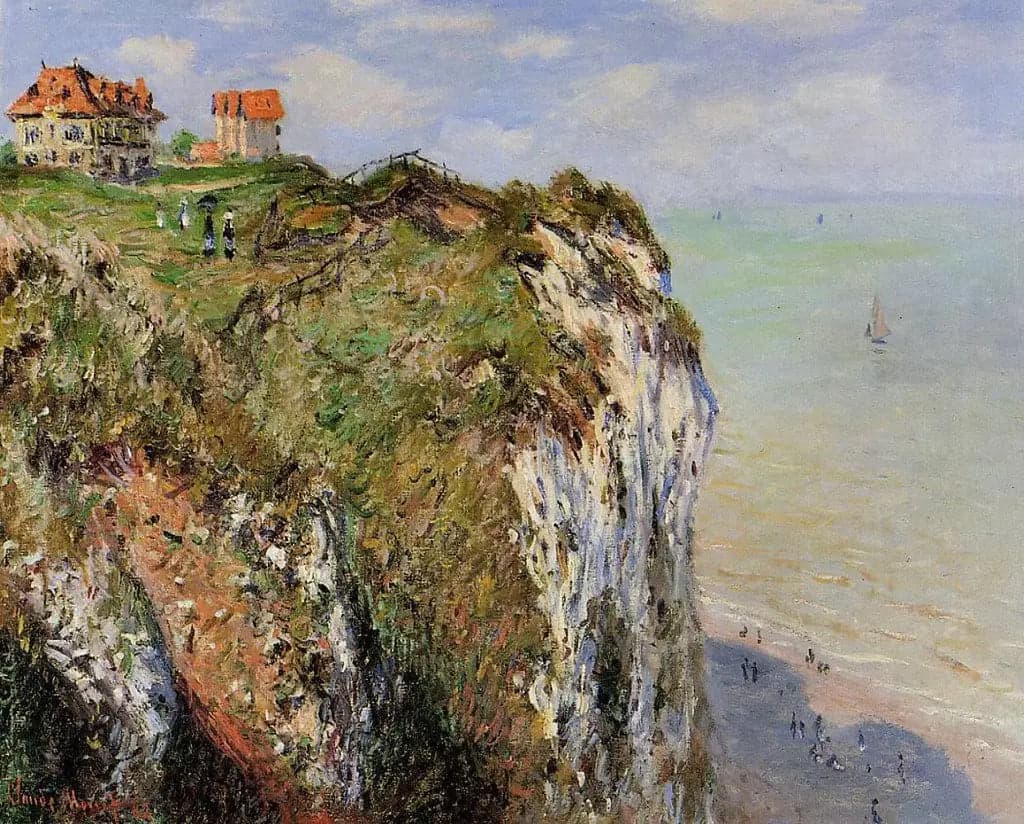
The Cliff at Dieppe
- Original dimensions
- 82 x 66 cm
- Museum
- Kunsthaus Zurich
- Year
- 1882
Scene depicted
This painting depicts the majesty of the chalk cliffs that dominate the coastline of Dieppe, merging sky and sea in a dance of oil. The waves break lightly, while the sunlight caresses the whole, in a delicate play of shadows and sparkles. The vibrant colors echo the soul of Normandy, where Monet's inspiration resonates in every shade of blue and green, revealing a world in perpetual transformation.
Historical context
Year: 1882 |BRK| Museum: Kunsthaus Zurich |BRK| Dimensions: 82 x 66 cm
Place in the artist's career
The Cliff at Dieppe , a flagship work of Monet's career, marks a pivotal period in his artistic exploration. It is situated between other iconic paintings such as Impression, Sunrise and The Water Lilies , reflecting the artist's stylistic evolution. With this painting , Monet not only takes a step towards chiaroscuro but embodies the very essence of Impressionism , playing with light like never before.
Anecdote
“Light always invites itself to my canvases,” Monet said one April morning, in front of the sea stirred by the breath of the wind, in Dieppe. It is in this gentle melancholy, while contemplating the horizon, that he saw this painting come to life, a visual melody that promised to sing to the hearts of souls. The intensity of the light captured in the painting transports us to an almost ethereal world.