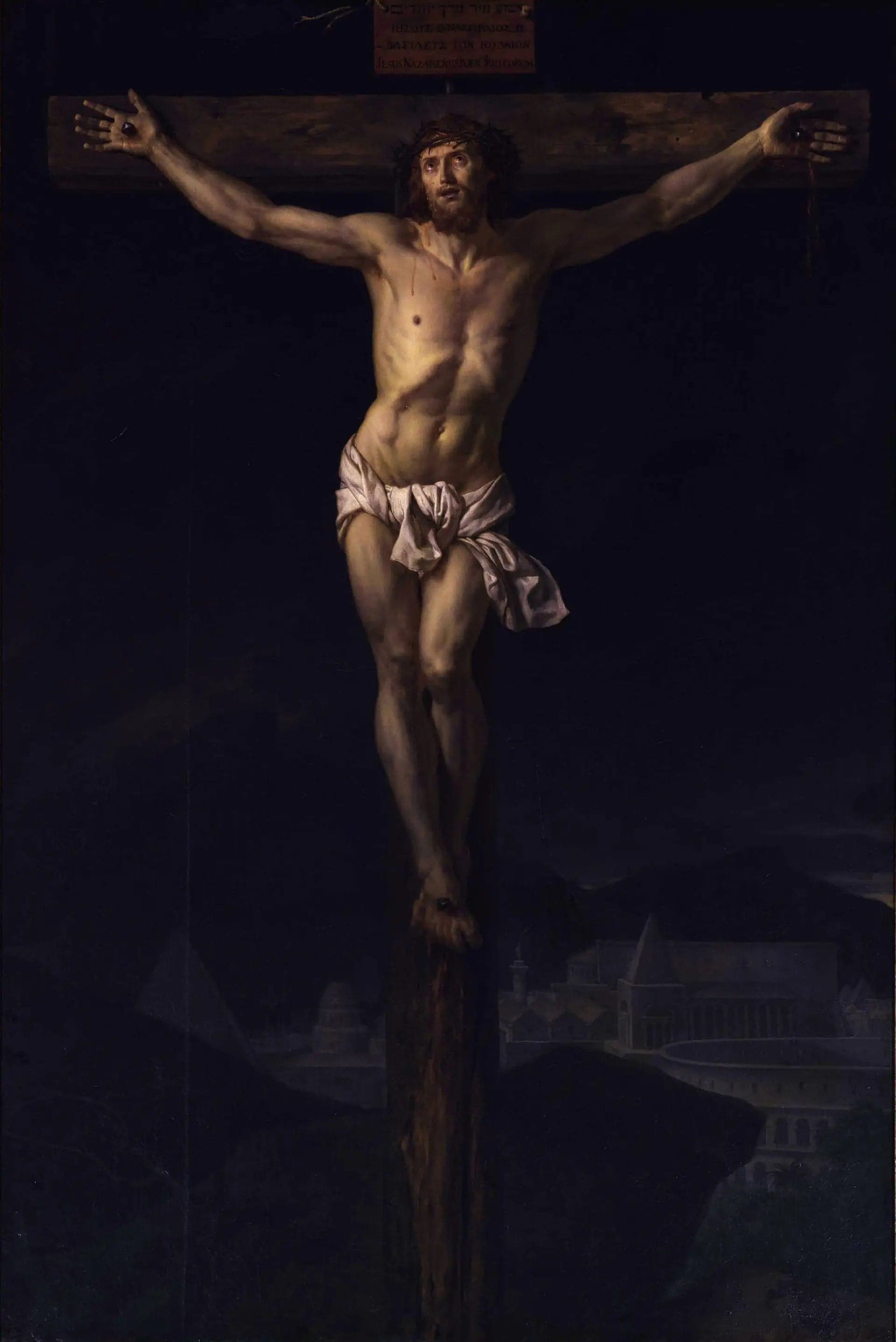
The Christ on the Cross - Jacques
- Original dimensions
- 188 x 276 cm
- Movement
- neoclassicism
- Museum
- Saint-Vincent Cathedral, Mâcon
- Year
- 1782
Scene depicted
The painting “The Christ on the Cross” by Jacques-Louis David depicts the tragic moment of Jesus' crucifixion, where the emaciated body, suspended between heaven and earth, embodies both pain and sacrifice. The composition imposes a contemplative silence, a solemn atmosphere enhanced by light and darkness, symbolizing the eternal struggle between life and death.
Historical context
Created in 1782, this painting is emblematic and is located in the beautiful city of Mâcon, in Burgundy, at the heart of an era marked by neoclassicism . This movement, born in reaction to the rococo, advocates values of heroism and rationalism. Today, this canvas strikes with its majesty and understanding of human drama, displayed in the Saint-Vincent Cathedral.
Place in the artist's career
This painting represents a turning point in David's career, reinforcing his status as an icon of neoclassicism . It is situated between “ The Oath of the Horatii ” and “The Departure of the Volunteers,” two paintings that illustrate his stylistic and emotional evolution, with an increased focus on psychological depth and visual storytelling.
Anecdote
Jacques-Louis David once confided: “The pain expressed in the painting must touch the hearts of those who contemplate it.” This moment of inspiration unfolds as he observes a rainy sky, where the last rays of sunlight illuminate a face of suffering. These powerfully evocative impressions are reflected in his majestic canvas , where each brushstroke tells a story.
Major exhibitions
The Baroque of Enlightenment