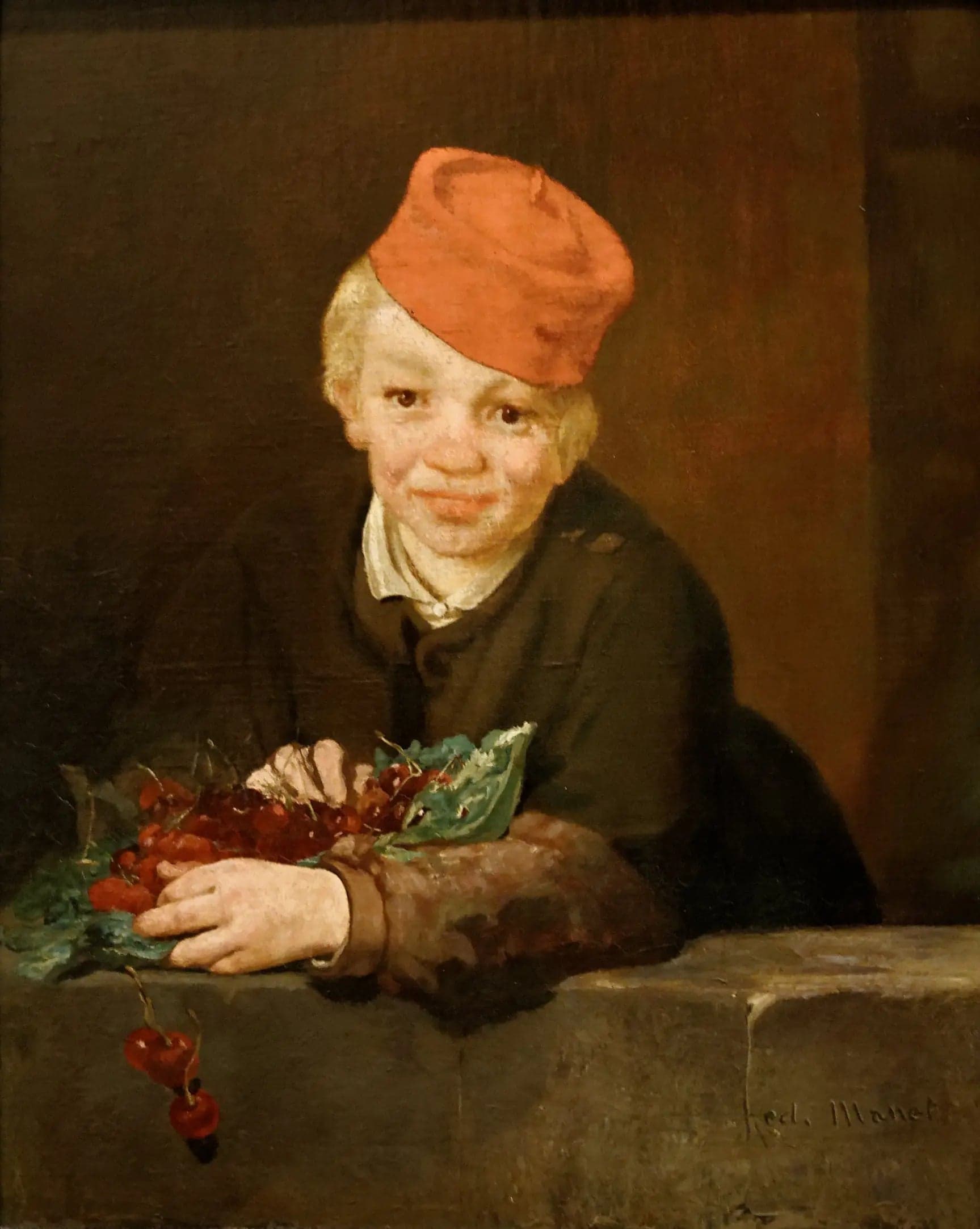
The Child with Cherries
- Original dimensions
- 54.5 x 65.5 cm
- Museum
- Calouste-Gulbenkian Museum
- Year
- 1858
Scene depicted
The Child with Cherries features a young boy, lost in the innocence of a bucolic childhood, awaiting the gaze of passersby while firmly holding a basket filled with juicy fruits. This painting , with its delicate composition, highlights the simplicity of summer pleasures while capturing the ephemeral beauty of childhood moments.
Historical context
Created in 1858, this painting is a pioneer of modernity, born under the Parisian sky, in the heart of a France in full artistic effervescence. A painting that encapsulates not only the momentum of the time but also the identity of a bubbling movement, realism . The work is currently exhibited at the Calouste-Gulbenkian Museum in Lisbon, where it continues to fascinate visitors with its elegant dimensions.
Place in the artist's career
This masterpiece , one of Manet's early successes, offers a valuable insight into his emerging style. It marks his career alongside other iconic paintings , such as “Luncheon on the Grass” and “Olympia,” marking a turning point towards modernity and the questioning of the artistic conventions of the time.
Anecdote
“The morning light dances among the cherries,” Manet might have said as he contemplated a familiar scene, an image captured in the fleeting moment of a sweet morning. This fleeting moment, fixed on his canvas , transcends mere visual pleasure and evokes the simple joy of a shared instant, linked to the painting of everyday life.