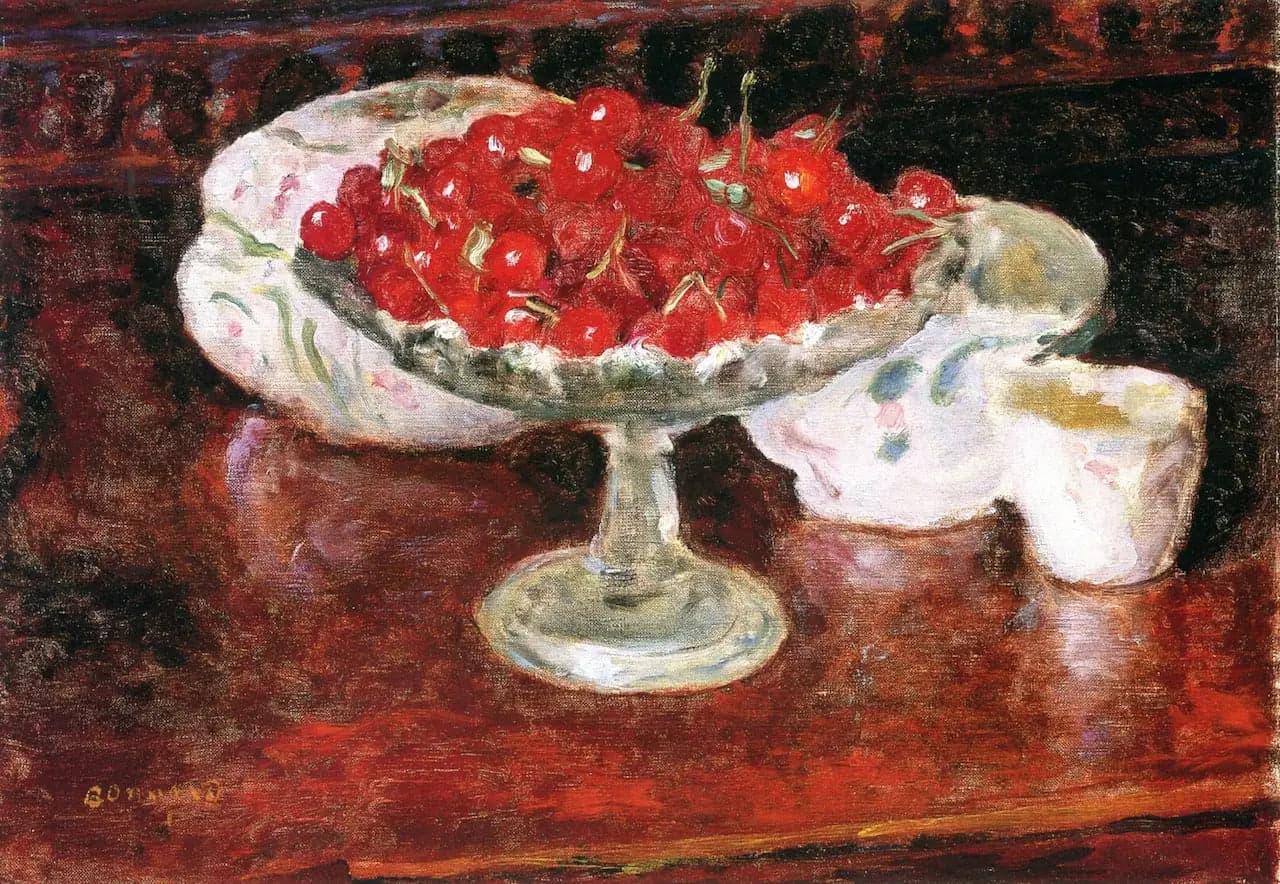
The Cherry Bowl
- Original dimensions
- 41.91 x 30.16 cm
- Museum
- Phillips Collection
- Year
- 1920
Scene depicted
The Cherry Bowl is a pictorial work where a contrast between natural light and everyday life plays out gracefully. The composition, centered on vibrant cherries, serves as a premise for a sensitive narrative, revealing the intimacy of simple moments. Every detail, from the reflection of the fruit to the subtle nuances of light, creates a warm atmosphere conducive to contemplation.
Historical context
Created in 1920 in the vibrant context of the city of Washington, D.C., this painting belongs to the nabi movement, an artistic current that advocates intuition and sensation over representation. The current canvas is carefully preserved at the Phillips Collection , testifying to its lasting impact on the world of modern art.
Place in the artist's career
This painting marks a fundamental turning point in Bonnard's evolution. It illustrates a period of maturity, where mastery of colors, as seen in The Luncheon on the Grass and The Nap, overlaps with a more intimate and introspective exploration of his subjects. In doing so, The Cherry Bowl becomes a key piece of his pictorial legacy.
Anecdote
“I aspire to capture the brilliance of a moment, like a note from a symphony,” Bonnard is said to have remarked one sunny morning. This desire to transcribe sensations brought The Cherry Bowl to life, evoking the sweetness of spring and the richness of shared memories around a table.