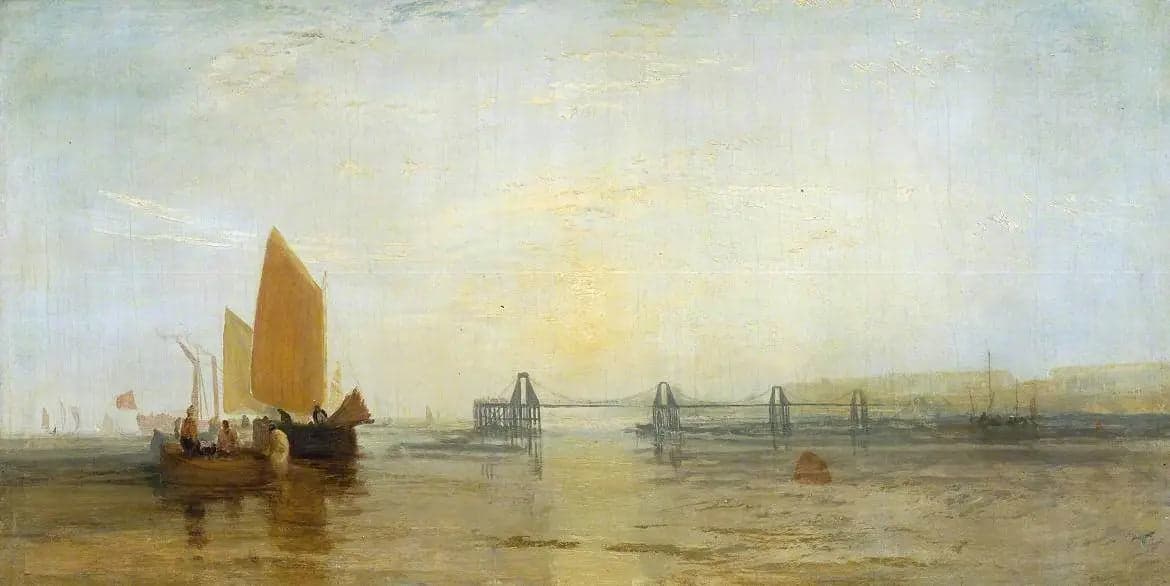
The Chain Pier, Brighton
- Original dimensions
- 71.1 x 136.5 cm
- Museum
- Tate
- Year
- 1828
Scene depicted
This canvas illustrates the majesty of the Chain Pier in Brighton, a symbol of the Victorian era. The spectacle of sailing boats navigating under a stormy sky reveals the contrasts of human nature, between passion and storm. The painting transports the viewer to the water's edge, where the cries of seagulls and the sound of waves blend to create a symphony of sensations.
Historical context
Created in 1828, this painting is located in Brighton, an iconic seaside resort in England whose charm has captivated many artists. Joseph Mallord William Turner , an emblematic figure of Romanticism , managed to capture the essence of this place through his pictorial work. The canvas , now preserved at the Tate , evokes the connection between nature and man, while reflecting the era of an England in full transformation. Its imposing dimensions of 71.1 x 136.5 cm capture the vastness of the maritime scene.
Place in the artist's career
This masterpiece marks a pivotal period in Turner’s career. After works like "The Fighting Temeraire" and before "Rain, Steam and Speed", The Chain Pier, Brighton represents the pinnacle of a style where light and color reign supreme. Turner refines his approach to nature here, combining in his painting dramatic and poetic elements.
Anecdote
“Art is the mirror of the soul; everything that is seen must be felt.” Inspired by the shimmering lights of a spring morning, Turner sketched this work on the spot, feeling the gentle thrill of the waves and the sea breeze on his skin. Thus was born this painting , a vibrant testimony to his passion for the sea and its infinite beauty.