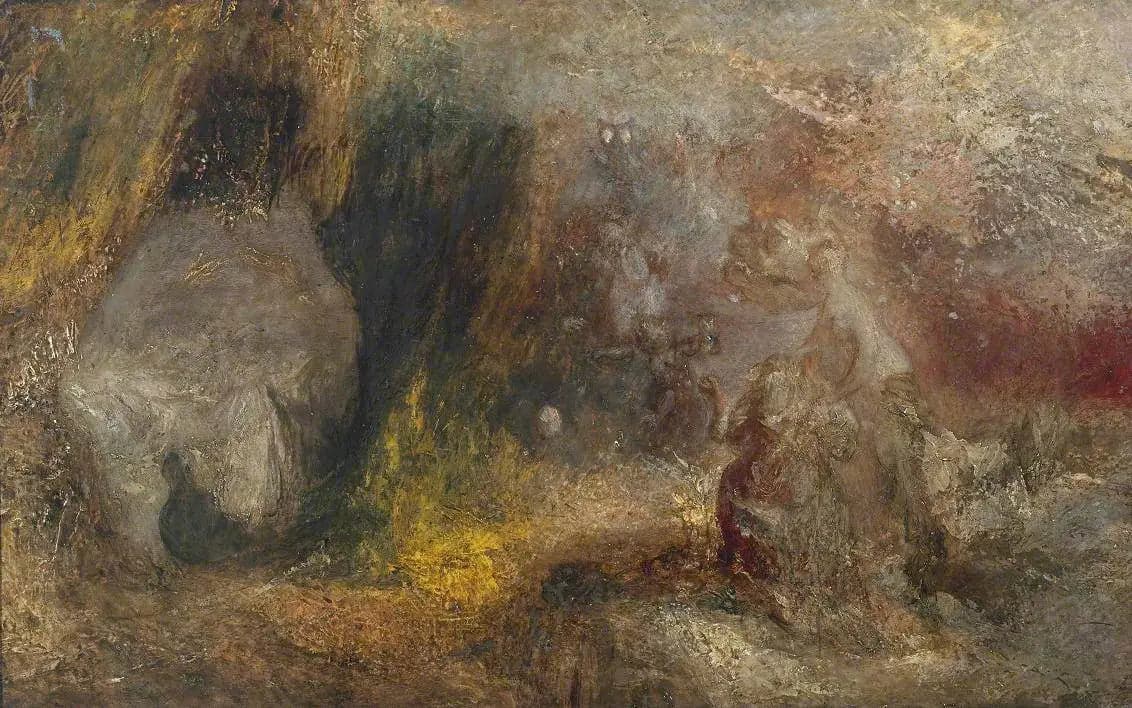
The Cave of Despair
- Original dimensions
- 50.8 x 81.3 cm
- Museum
- Tate
- Year
- 1835
Scene depicted
This painting reveals a poignant scene, where characters struggle against untamed nature. Through dying light, the shadows of the rocks are outlined with ruthless intensity, accentuating the depth and sadness present in this frozen moment. Turner manages to capture humanity's tumultuous struggle against the forces of nature, making this canvas all the more conducive to reflection.
Historical context
In 1835, at the heart of British fascination with the sublime and the romantic , Joseph Mallord William Turner captures a scene that is both devastating and captivating. Evolving within the romantic movement, The Cave of Despair is deeply rooted in England's artistic heritage. The canvas is currently part of a precious collection at the Tate museum in London, reflecting a time when the landscape became a mirror of the human soul.
Place in the artist's career
The Cave of Despair proves to be a turning point in Turner's artistic evolution, representing a period of maturity where the impressionist movement began to emerge. Compared to works such as The Fighting Temeraire (1839) and Rain, Steam and Speed (1844), this painting illustrates a bolder approach to contrasts and atmosphere, marking a glimpse towards an innovative pictorial language.
Anecdote
“A painting must evoke the very breath of emotion,” Turner is said to have declared, inspired by the spectacular landscapes of the English coasts. One foggy morning, while standing on cliffs overlooking a tumultuous sea, he imagines the horizon where light evokes both hope and desolation. It is this duality that breathes life into his masterpiece, The Cave of Despair.