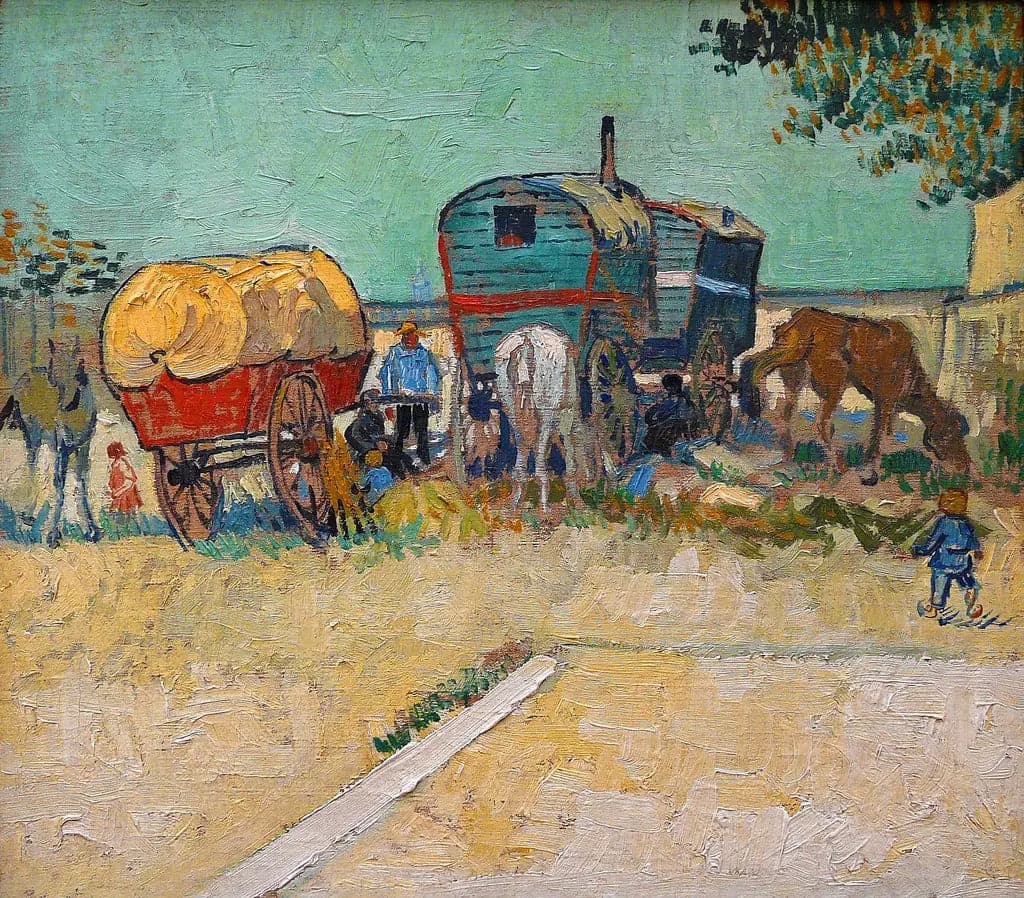
The Caravans, a Bohemian Camp near Arles
Scene depicted
This painting highlights the camp of artists and bohemians, evoking a friendly atmosphere where nature intertwines with daily life. The caravans are a symbol of freedom and creativity, moored on the outskirts of Arles , suggesting a life rhythmically guided by the seasons and colors. The vibrant hues of the canvas convey a deep sense of peace and connection with the surrounding world.
Historical context
Created in 1888, the painting “The Caravans, Bohemian Camp near Arles” comes to life in the bright city of Arles , an iconic location in the south of France. This painting belongs to the post-impressionist movement, where Van Gogh managed to capture the essence of bohemian life in his vibrant works. Currently, this painting is exhibited at the Orsay Museum in Paris , measuring 51 x 45 cm, a format that allows for immersion in the rich details of this canvas .
Place in the artist's career
“The Caravans” marks a crucial period in Van Gogh's career, a time when his style fully asserts itself. This painting, alongside works like “ The Starry Night ” and “ The Sunflowers ”, denotes an evolution in his use of color and light, revealing an artist pouring passion and emotion into every brushstroke. It is a milestone that testifies to his journey towards the peak of his creative genius.
Anecdote
“The light I see here is incredible, every color inspires me!” Van Gogh might have said as he contemplated the gentle landscape and the caravans at dawn on a spring day. It was in this enchanting setting, where the songs of cicadas mingled with the sweetness of the sun's warmth, that he drew the creative energy to give birth to this iconic artwork .