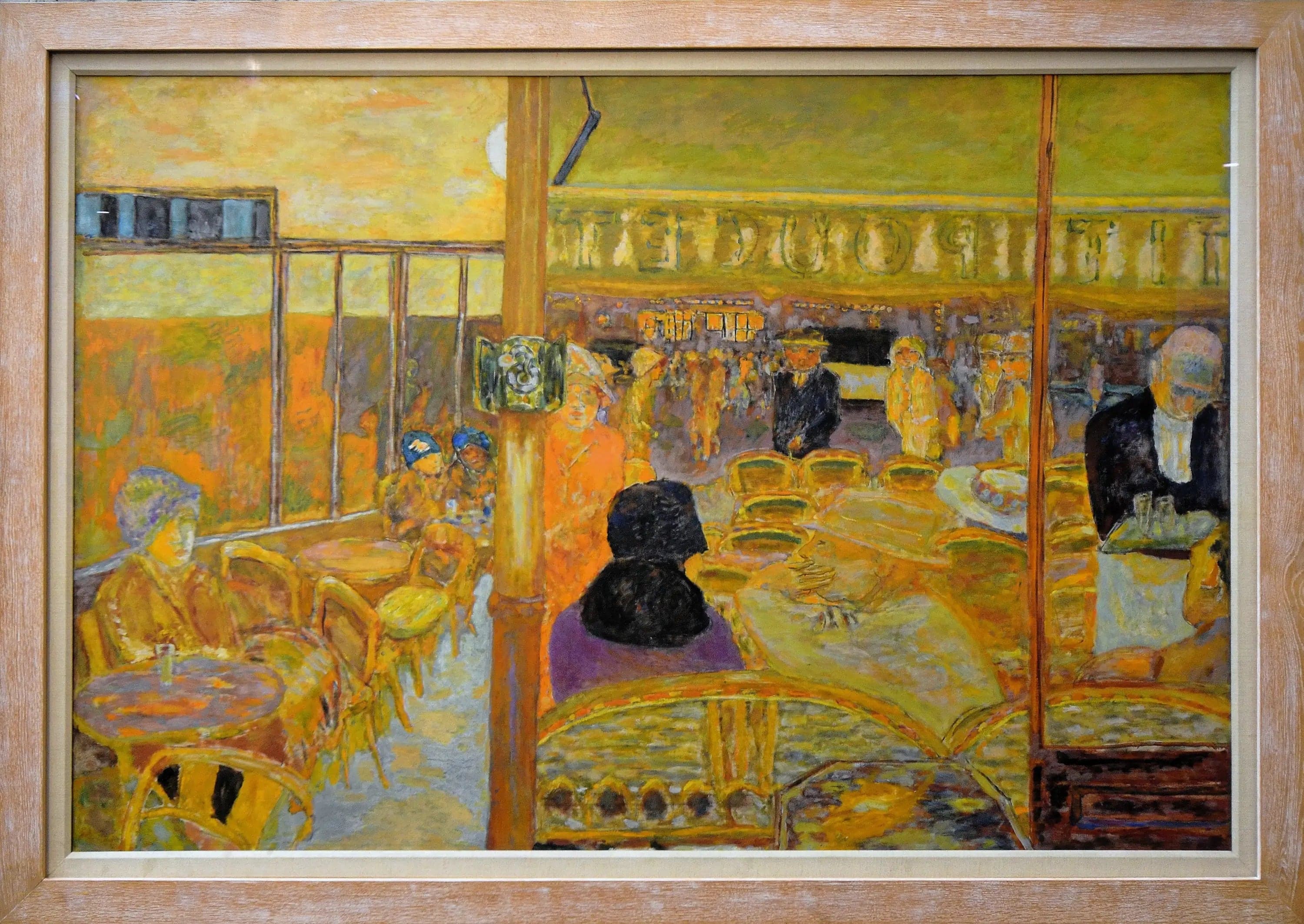
The Café Au Petit Poucet
- Original dimensions
- 206 x 140 cm
- Museum
- musée des Beaux-Arts et d'Archéologie de Besançon
- Year
- 1928
Scene depicted
In Le Café Au Petit Poucet , Pierre Bonnard transports us to an intimate atmosphere where friendliness and human warmth emanate from every element. This painting captures the lightness of Parisian life, where silhouettes gather around small tables, the background vibrant with activities and emotions. The work illustrates not only a scene of life but also a moment of fleeting happiness, paying tribute to the beauty of everyday moments.
Historical context
Created at the end of the 1920s, Le Café Au Petit Poucet perfectly embodies the spirit of post-impressionism , an artistic movement that emphasizes color and light. Located in Besançon, this major work is a gateway to the sensory experience of a Parisian café, where one can almost hear the murmur of conversations and the clinking of cups. Currently exhibited at the musée des Beaux-Arts et d'Archéologie de Besançon, this painting is fascinating and measures 206 x 140 cm, showcasing Bonnard's unparalleled talents.
Place in the artist's career
Le Café Au Petit Poucet represents a turning point in Bonnard's career, reflecting his artistic maturity. This pictorial work fits perfectly into his journey, alongside works such as Les Nymphéas by Claude Monet and Les Cuisinières by Bonnard himself, which demonstrate his evolution towards compositions rich in textures and emotions. This painting is a testament to an artist in search of light and color, resulting in a harmonious realization.
Anecdote
“A good painting is not a sum of colors, but a mirror of the soul.” This quote summarizes the essence of the masterpiece that Le Café Au Petit Poucet represents. One dawn morning, as the light makes its way through the veils of the city, Bonnard found inspiration in a daily scene: the brightness of a smile, the aroma of steaming coffee, the warm embrace of lights. This canvas is the echo of that fleeting moment, a moment frozen in time.