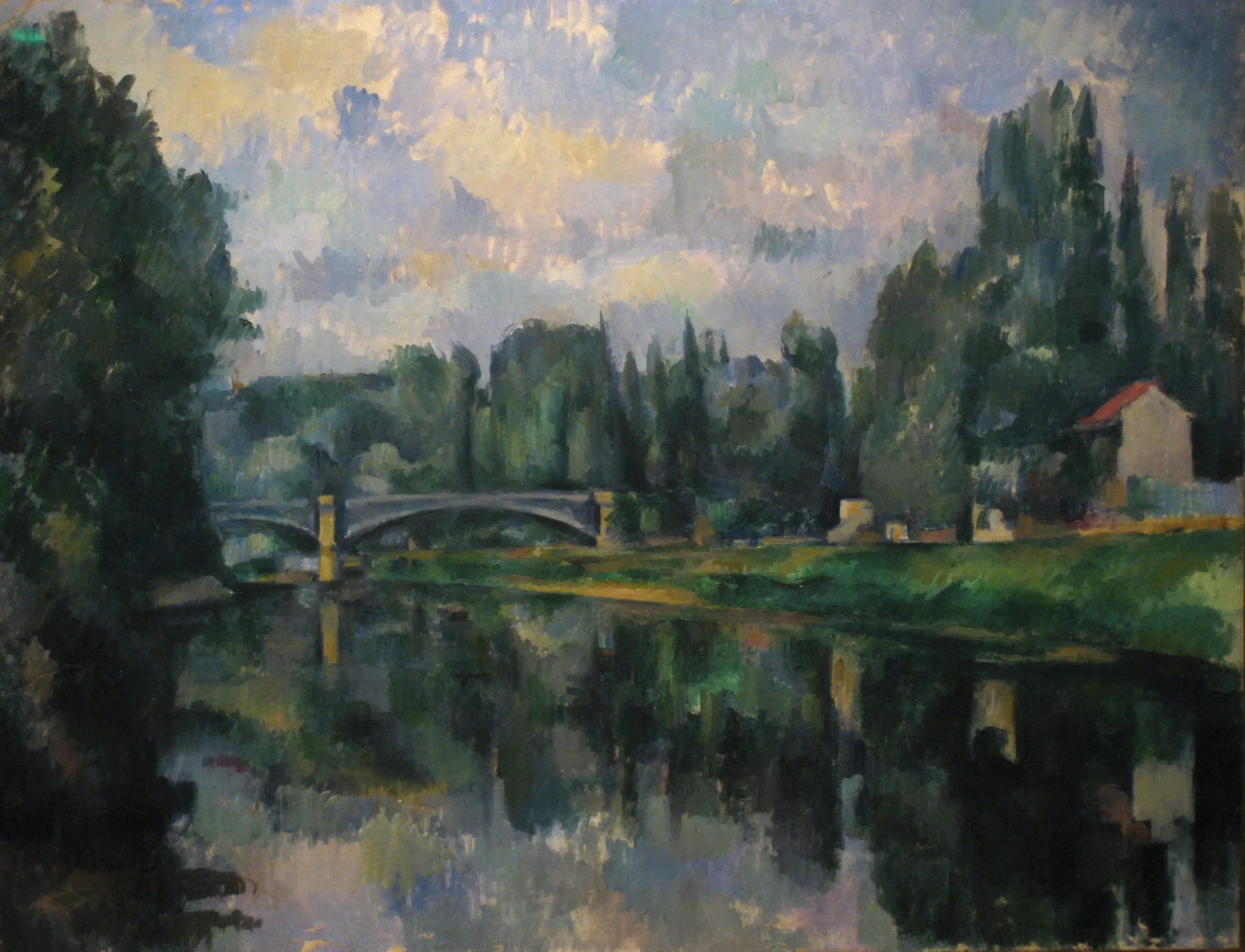
The Bridge over the Marne at Créteil
- Original dimensions
- 90 x 71 cm
- Museum
- Pushkin State Museum of Fine Arts
- Year
- 1894
Scene depicted
The painting depicts a tranquil scene where the bridge majestically rises above the Marne, merging with the ruggedness of the surrounding vegetation. Through the prism of Cézanne's eye, each brushstroke tells a story, an interaction between the elements of nature, like a gentle dance between the sky and the water. This pictorial work, enriched with subtle nuances, invites us to dive into a moment suspended in time.
Historical context
Created in 1894, this painting emblematic of Paul Cézanne is rooted in the poetic landscape of Créteil, France. A witness to a time when the Impressionist movement began to distance itself from conventions, the canvas captures an atmosphere that blends harmony and light, while fitting into the artistic movement that advocates the expression of visual perception. Today, this work , exhibited at the Pushkin State Museum of Fine Arts , fascinates with its generous format of 90 x 71 cm that irresistibly draws the eye.
Place in the artist's career
The Bridge over the Marne at Créteil is part of a pivotal period in Cézanne's career, marking a stylistic turning point. At the dawn of his Expressionism , it dialogues with other major canvases like Mont Sainte-Victoire and The Large Bathers , both revealing a quest for balance and structure in his pictorial approach.
Anecdote
“Nature is an artist, and I am just a humble observer,” Cézanne is said to have declared while contemplating the landscape of his paintings. On a bright spring morning, let us imagine the artist strolling by the Marne, his eyes fixed on the bridge, the light dancing on the serene waters. This sublime vision could only settle in his mind, becoming the evocative force of The Bridge over the Marne at Créteil .