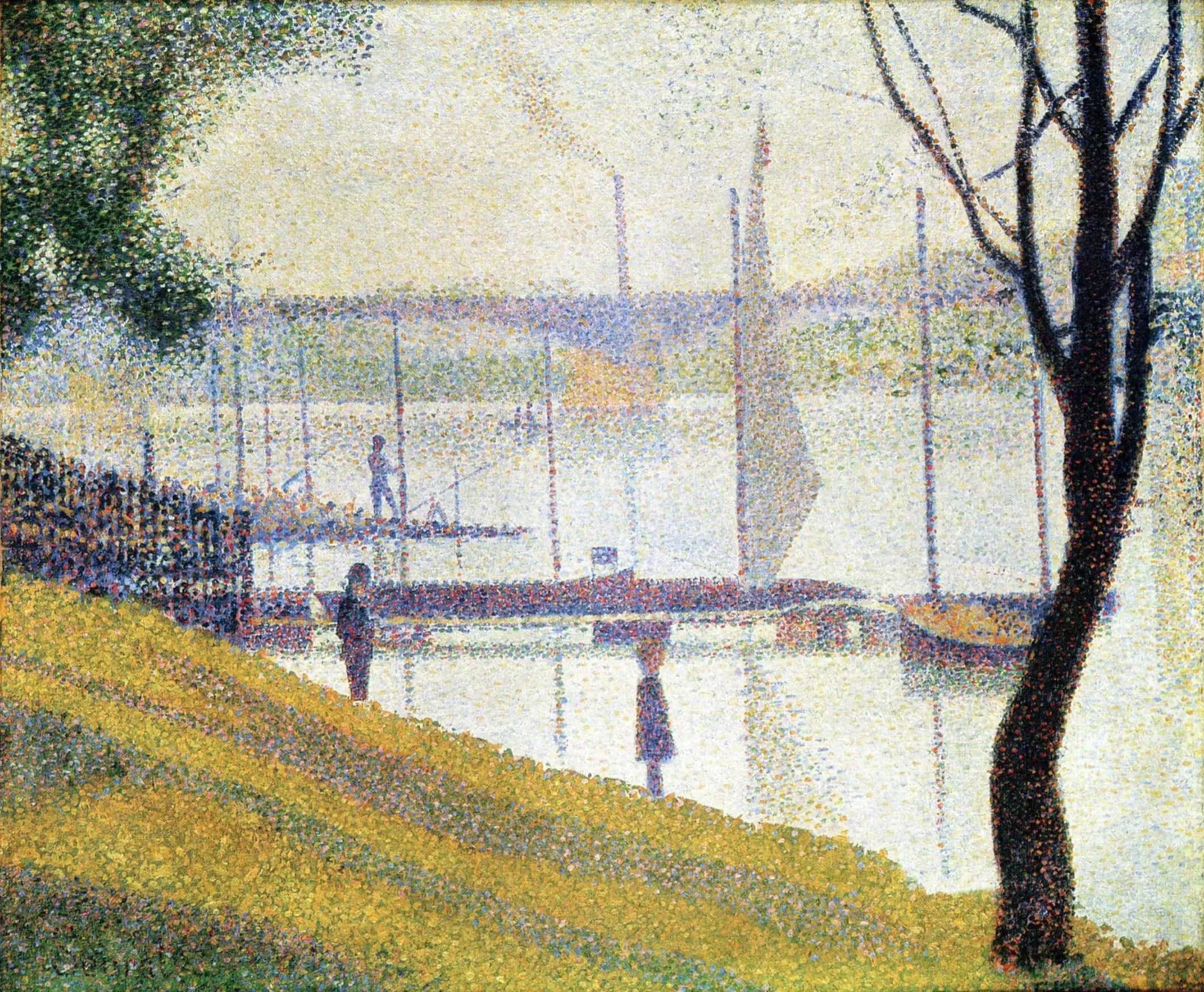
The Bridge of Courbevoie
- Original dimensions
- 53.3 x 46.4 cm
- Movement
- neo-impressionism
- Museum
- Courtauld Gallery
- Year
- 1880
Scene depicted
In "The Bridge of Courbevoie," a bucolic scene unfolds, a stolen moment of peaceful life on the banks of the Seine. The canvas evokes an atmosphere of tranquility, with walkers and boats gliding gently on the water, as light plays with shadows and reflects the colors of the surrounding nature. This harmonious composition transports us to a world where time seems suspended.
Historical context
Created in 1880, the painting "The Bridge of Courbevoie" is deeply rooted in the neo- impressionist movement that emerged in Paris, a vibrant city full of artistic effervescence in the 19th century. This canvas , currently housed at the Courtauld Gallery , reflects Seurat's creative commitment to light and shadow in an urban setting. Through its dimensions of 53.3 x 46.4 cm, this pictorial work captures the essence of a moment suspended by the Seine.
Place in the artist's career
The Bridge of Courbevoie represents a crucial step in the career of Georges Seurat , marking a promising beginning towards his distinctive style. Alongside other iconic paintings like "A Sunday Afternoon on the Island of La Grande Jatte" and "La Grande Jatte," this pictorial work illustrates his technical and emotional evolution, transitioning from a simple impressionist stroke to a true neo- impressionist masterpiece.
Anecdote
“Light is the key to painting.” This quote, faithfully inspired by Seurat, perfectly summarizes the essence of his masterpiece . Imagine him, one spring morning, walking along the banks of the Seine in Courbevoie, with the sweet scent of flowers in the air, when this painting began to take shape in his mind. The painting thus becomes a testament to those moments stolen from everyday life.