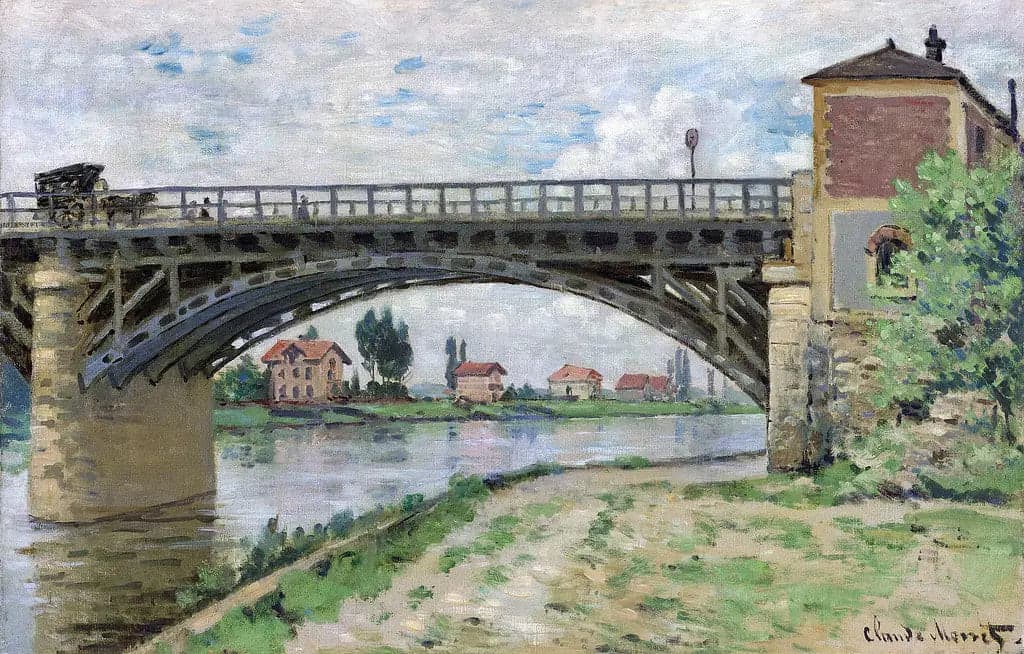
The Bridge at Argenteuil
- Original dimensions
- 800 x 600 cm
- Museum
- Orsay Museum
- Year
- 1874
Scene depicted
This vibrant painting immortalizes a fleeting moment on the Bridge at Argenteuil , capturing the beauty of reflections in the water and the bustle of daily life. Sailboats glide delicately on the Seine, while figures stroll leisurely on the bridge, enveloped by the soft light of late afternoon. The canvas becomes an ode to serenity and the beauty of French landscapes, a testament to Monet's fascination with the interplay of light and color.
Historical context
Year: 1874 |BRK| Museum: Orsay Museum |BRK| Dimensions: 800 x 600 cm
Place in the artist's career
The Bridge at Argenteuil represents a crucial milestone in Monet's career, marking both his mastery of vibrant colors and his innovative technique. Compared to his earlier works such as Impression, Sunrise , this painting reflects an increasing confidence in the use of light and shadows. This masterpiece belongs to a flourishing period where Monet captured the immediacy of human emotions and natural landscapes.
Anecdote
“The light of that morning radiated all possible shades; it was a symphony of colors waiting to be captured.” These words could well summarize Monet's inspiration as he painted The Bridge at Argenteuil . Imagine him, one spring morning, dressed in his smock, floating near the water, absorbing the melody of the gentle lapping waves caressed by the wind: a vision coming to life under his brushes. This emotion, palpable in every brushstroke, animates the canvas and transforms it into a vibrant pictorial work.