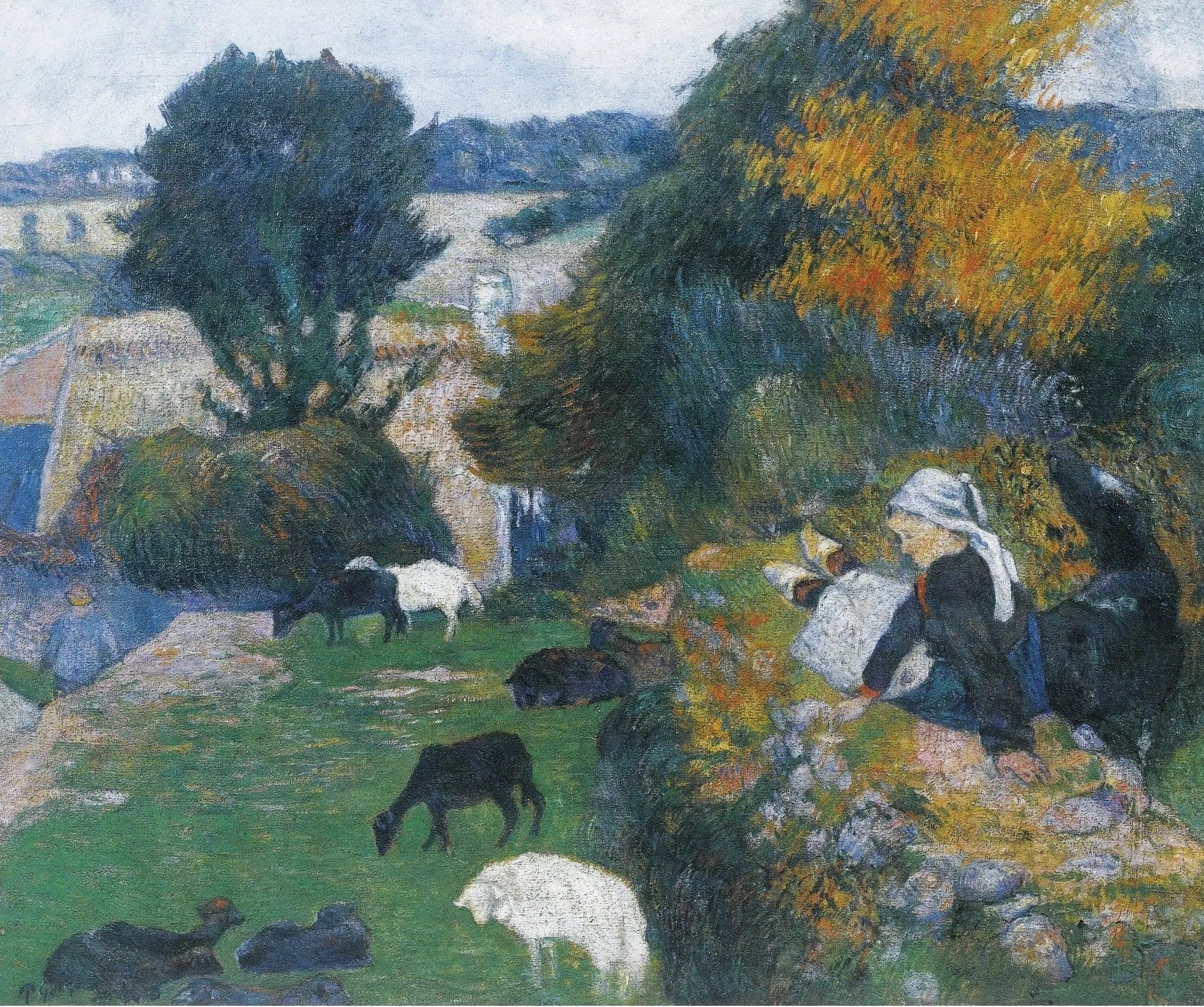
The Breton Shepherdess
- Original dimensions
- 73.3 x 60.4 cm
- Museum
- Laing Art Gallery
- Year
- 1886
Scene depicted
The shepherdess, the central figure of this painting, stands peacefully amidst a lush pastoral landscape. Dressed in her traditional garments, she seems in harmony with the land that surrounds her. This place, both real and imbued with dreams, incorporates elements of Breton culture, inviting the viewer into a silent story where each element tells its own legend.
Historical context
Created in 1886, The Breton Shepherdess majestically fits into the artistic landscape of Brittany, a region that inspired so many masters. Paul Gauguin , an iconic figure of the post-impressionist movement, captured the soul of this land through this canvas that vibrates with life. Now displayed at the Laing Art Gallery, this work is a vibrant testimony to a time when art pushed the traditional boundaries, opening up to emotions and color.
Place in the artist's career
The Breton Shepherdess represents a pivotal period in Gauguin's career, marking the transition to a more symbolic and personal approach to painting . Parallel to his masterpiece Vision After the Sermon and the painting The Yellow Christ, this work illustrates his desire to transcend the everyday through art, affirming his unique style.
Anecdote
“Art is not an objective representation, but an exteriorization of the soul,” Gauguin might have said. Imagine him, one spring morning, wandering through the Breton hills. It is in this moment of contemplation that the idea for this painting was born, capturing not only a shepherdess but the essence of a simple life rooted in nature. A deep connection emerges, which even today resonates in every brushstroke of this painting .