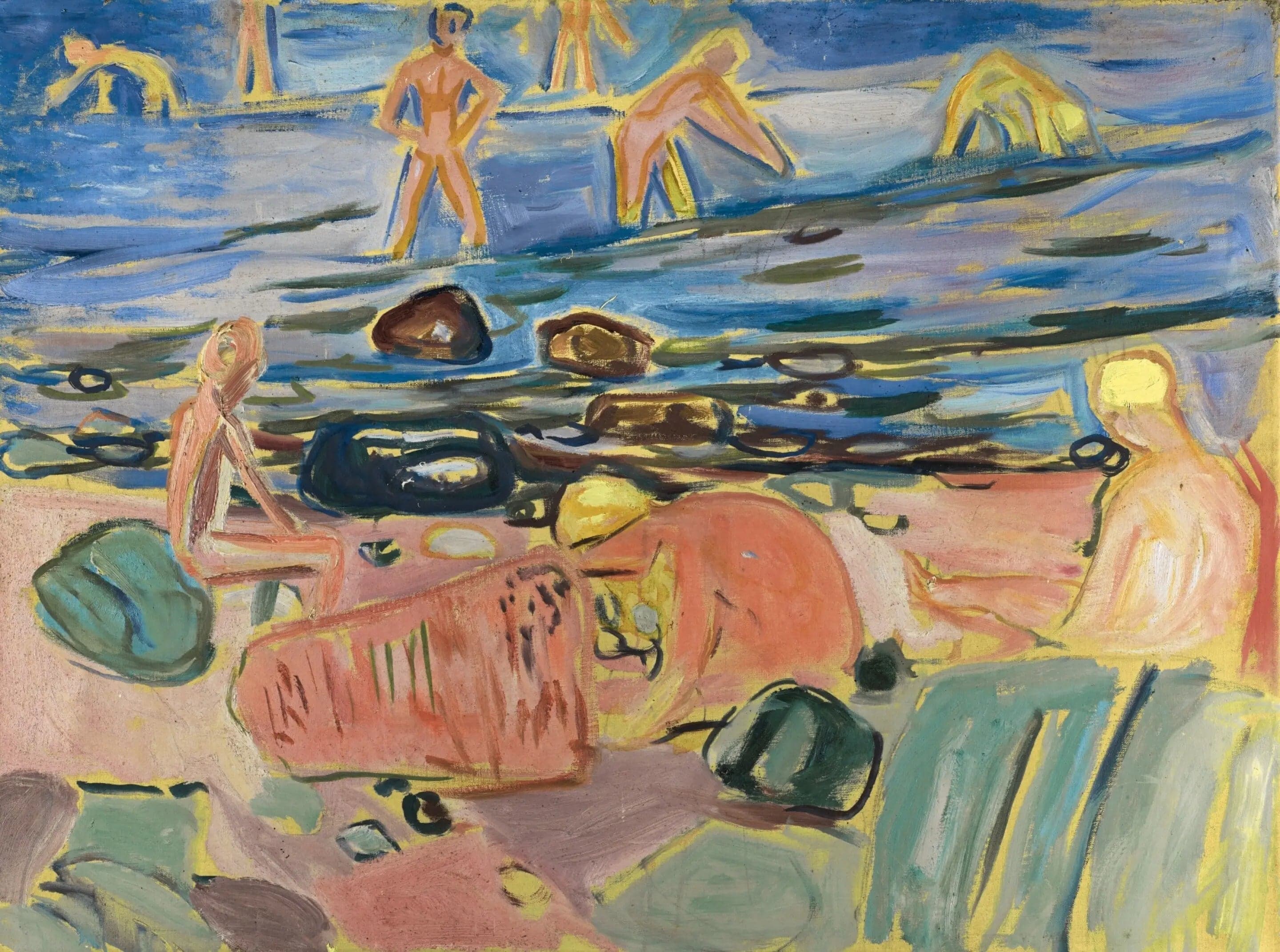
The Boys Bathing
- Original dimensions
- 150 x 92 cm
- Museum
- National Gallery of Oslo
- Year
- 1894
Scene depicted
In this canvas , the young boys, bathed in light, engage in a playful water game, a snapshot of pure joy. The graceful bodies, amidst laughter and water games, evoke an atmosphere of freedom and carefreeness. The sea, both serene and mysterious, surrounded by vibrant nature, becomes a reflection of their enthusiasm and youth, transcended by Munch's artistic vision.
Historical context
Created in 1894, this painting is emblematic and rooted in Oslo, a city rich in a vibrant cultural and artistic history. Edvard Munch , a major figure of the expressionist movement, uses this painting to explore themes of innocence and vulnerability related to childhood. Currently exhibited at the National Gallery of Oslo , this canvas bears witness to a fragment of an era where human emotions begin to take a prominent place in art.
Place in the artist's career
The Boys Bathing represents a milestone in Munch's journey, marking the balance between the beginning of his career and the emergence of his characteristic style. When comparing this painting to other masterpieces such as The Madonna and The Scream, one perceives an evolution towards a more intense and personal expression of his feelings, in the face of universal themes such as life and death.
Anecdote
“Childhood is the state of mind where one marvels at the clarity of the day.” It is within this framework that Munch drew his inspiration for this pictorial work . One fresh morning, in a summer garden, surrounded by the laughter of children, he captured this radiant light reflecting on the water of a lake, encapsulating the very essence of childhood through his painting .