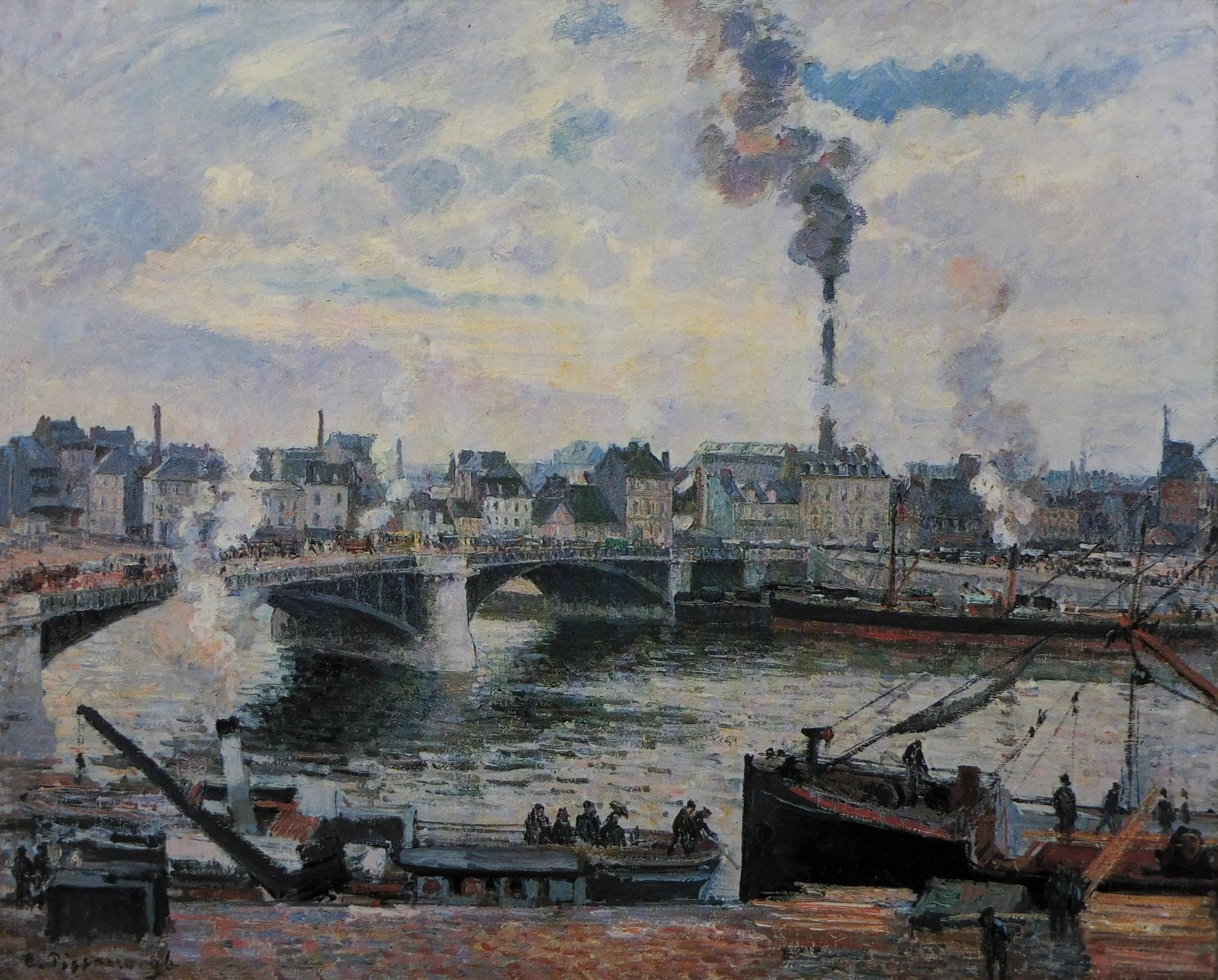
The Boieldieu Bridge and the Saint-Sever Suburb in Rouen
- Original dimensions
- 92 x 73 cm
- Museum
- Carnegie Museums of Pittsburgh
- Year
- 1896
Scene depicted
In this painting , the Boieldieu Bridge rises majestically, while the Saint-Sever suburb reveals its alleys lined with typical houses. Pissarro illustrates the daily life of the Rouennais, with animated silhouettes, vibrant colors, and light dancing on the water. This landscape resonates with the authenticity of a city undergoing transformation at the end of the 19th century, reflecting a provincial Paris.
Historical context
Created in 1896, this painting embodies the essence of Rouen, a Norman city with a rich history. Camille Pissarro , a major figure of the Impressionist movement, captured this vibrant urban scene at the heart of an era where art is reinvented. This canvas is now housed at the Carnegie Museums of Pittsburgh, attesting to its significance in the history of art.
Place in the artist's career
This painting marks a turning point in Camille Pissarro 's career, where his Impressionist style reaches maturity. In parallel with his works like “Boulevard Montmartre, Spring” and “The Apple Harvest,” an evolution in the expression of light and atmospheres can be perceived. This painting denotes a confident mastery of the living and vibrant landscape.
Anecdote
“The morning light, it is what inspired me.” These words from Camille Pissarro evoke the magic of a fleeting moment in a corner of Rouen. On that spring morning, the softness of the air and the murmur of the Seine's waters influenced this canvas . In this pictorial work , he managed to capture not only the view but also the soul of the place.