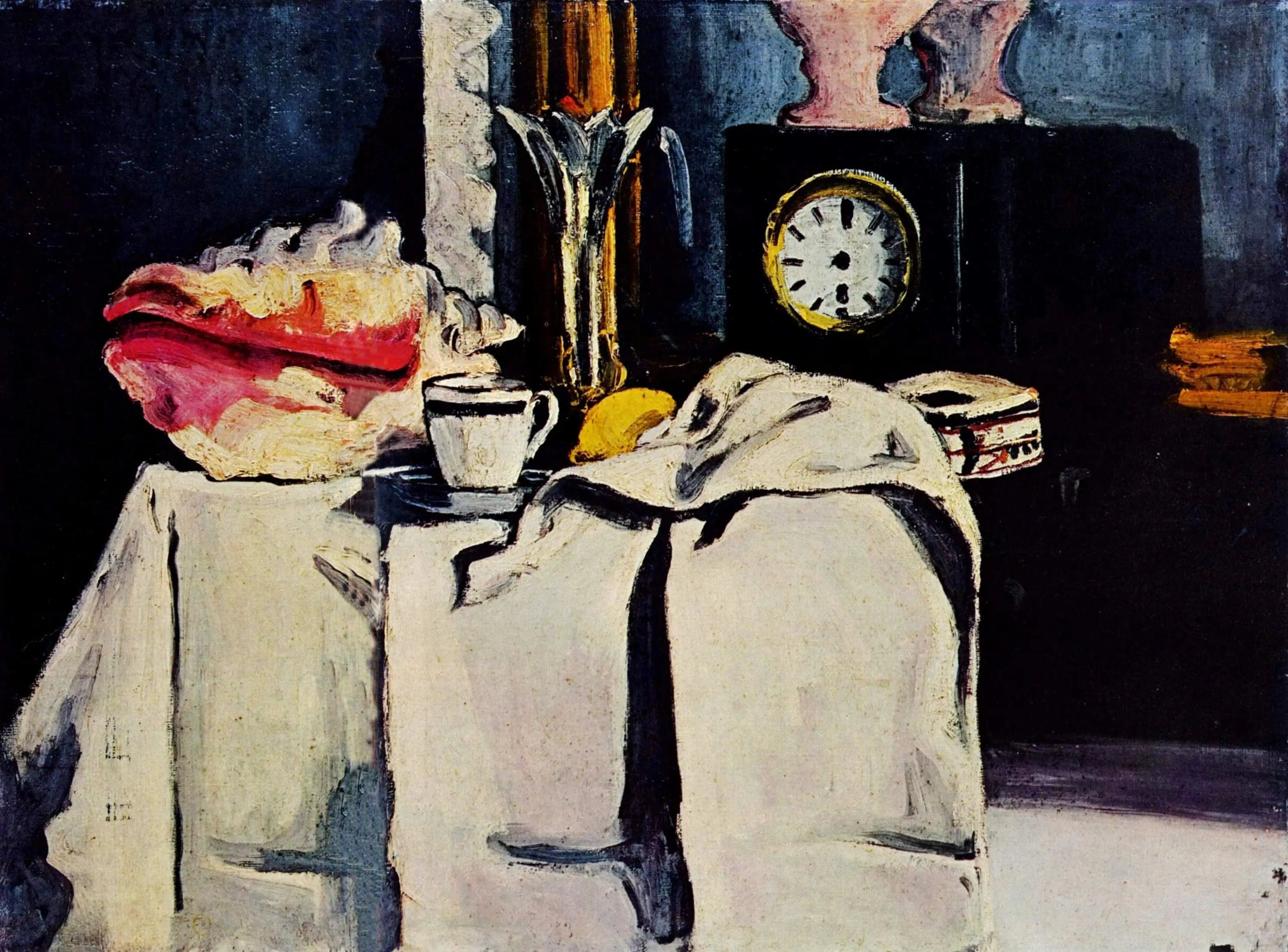
The Black Clock
- Original dimensions
- 74 x 54 cm
- Museum
- Stávros Niárchos Collection
- Year
- 1869
Scene depicted
In this masterpiece, Cézanne depicts a simple yet meaningful moment. The composition highlights a clock skillfully arranged, surrounded by everyday objects. Each element, meticulously chosen, offers a unique vision of the connection between humanity and the passage of time. An atmosphere of calm and serenity emanates from this canvas , resonating human emotions through the beauty of the everyday.
Historical context
Created in 1869, this painting emblematic finds its origin in the charming village of Aix-en-Provence, in the heart of French Provence. The canvas, from the Impressionist movement, embodies a significant period in the rise of Post-Impressionism . This exceptional painting is currently exhibited at the Stávros Niárchos Collection , where it continues to dazzle visitors with its timeless brilliance.
Place in the artist's career
The Black Clock is situated at a key moment in Cézanne's career, marking a turning point towards a more introspective and colorful exploration. In parallel, works such as “The Card Players” and “The Montagne Sainte-Victoire” testify to an undeniable stylistic evolution. It is during this period that Cézanne asserts himself as the master of forms and lights, crossing the boundaries of Impressionism .
Anecdote
“Beauty lies in the harmony of simple things.” These words of Cézanne resonate strongly when listening to his creative process. Imagine a spring morning, the sun's rays filtering through the branches of trees, a soft light gently caressing the shapes and shadows... This is the very essence of the Black Clock , painted as the world awakened to the beauty of each moment.