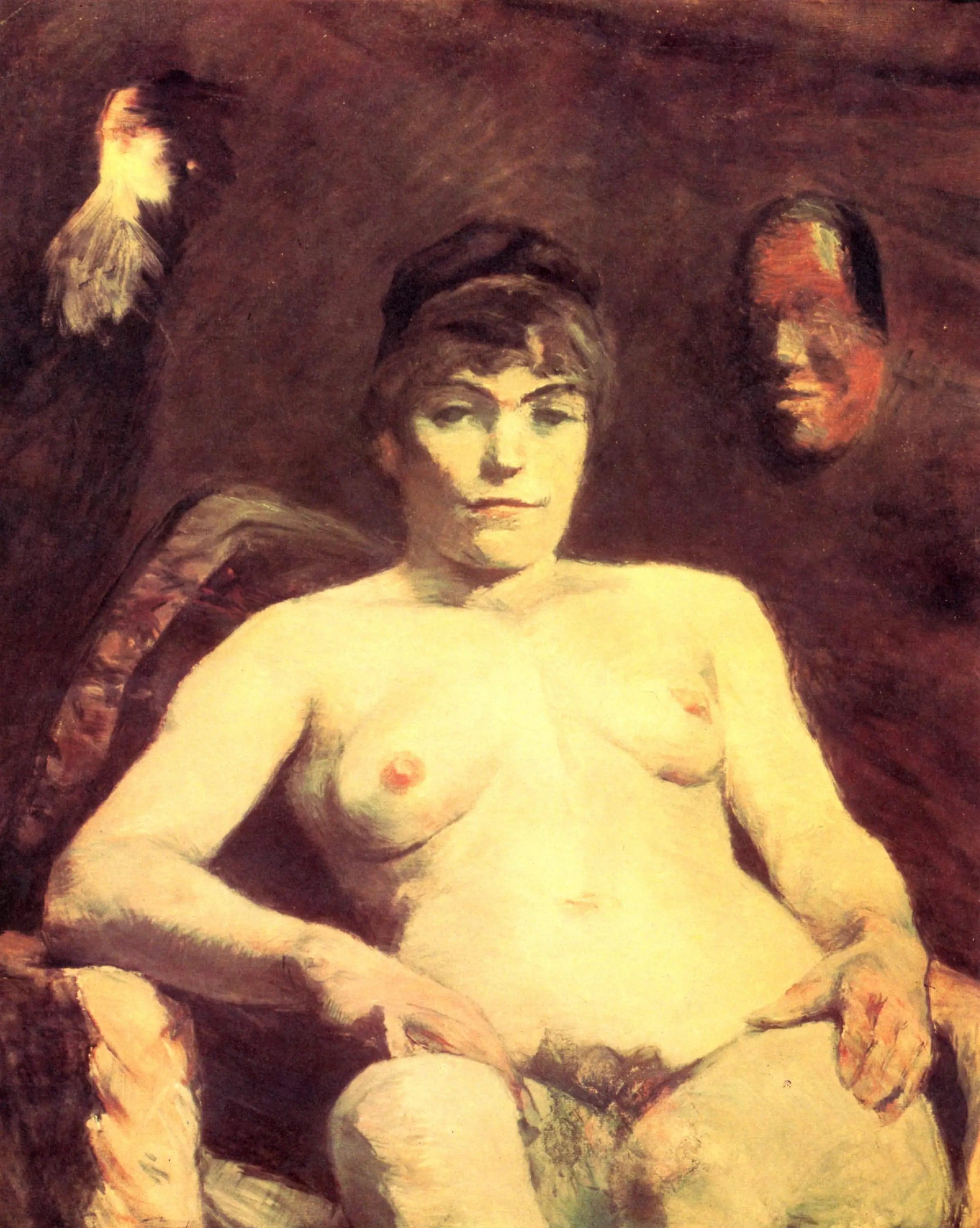
The Big Maria, Venus of Montmartre - Henri de Toulouse
- Original dimensions
- 64.8 x 80.7 cm
- Museum
- Von-der-Heydt Museum
- Year
- 1884
Scene depicted
This painting highlights Maria, embodying voluptuous beauty and Parisian nightlife. Toulouse-Lautrec, through bold and vibrant brushstrokes, captures a unique atmosphere alive with music and laughter, where the shadows of advantageous cafés intertwine with the warm light of lanterns. The figure of Maria, broad and expressive, transcends the simple features of a model, offering a reflection on the body, sensuality, and the daily life of the neighborhood artists.
Historical context
Created in 1884, this painting emerges in the artistic bubbling of Montmartre, a vibrant neighborhood of Paris. Rooted in the post-impressionist movement, The Fat Maria, Venus of Montmartre immerses us in the nightlife and sensuality of the Belle Époque, a time marked by cultural and social transformations. Currently, this canvas is located at the Von-der-Heydt Museum , carefully preserved to continue moving art lovers. Its dimensions, 64.8 x 80.7 cm, make it a canvas that is truly captivating.
Place in the artist's career
The Fat Maria, Venus of Montmartre sits at a turning point in Toulouse-Lautrec's career, marking his transition to bolder compositions. Alongside The Circus (1891) and Dance at the Moulin Rouge (1890), this canvas reveals a growing mastery of movement and emotion, transforming the simple portrait into a true visual narrative.
Anecdote
In a famous quartet of Parisian cafés, Toulouse-Lautrec captured the very essence of his models. He once declared: “Every face tells a story, and every painting is a page from the book of life.” While drawing inspiration from the bustling life of Montmartre, he encountered the striking face of Maria, an iconic figure of this neighborhood. This moment of encounter, captured on his canvas , reveals not only a portrait but also a joyful and melancholic introspection of the human condition.