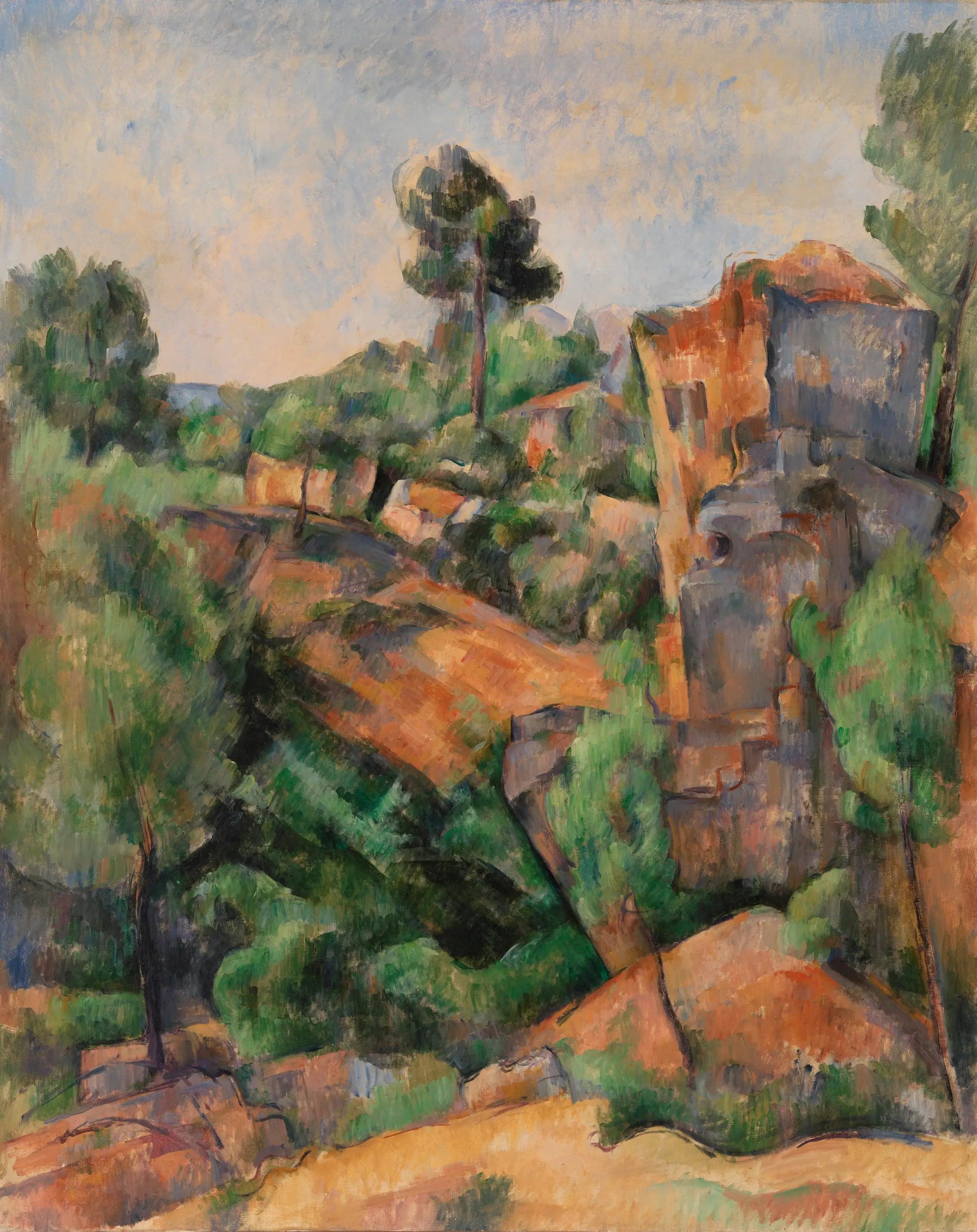
The Bibémus Quarry
- Original dimensions
- 54 x 65 cm
- Museum
- Not specified
- Year
- 1898
Scene depicted
In La Carrière de Bibémus , Cézanne transports us to the heart of a mineral landscape where rugged rocks rise majestically under a sky of changing hues. This painting represents not just a panorama; it captures the essence of an era and the dialogue between man and nature. Through its angular forms and bold composition, Cézanne invites the viewer to a silent contemplation of this land, where time seems suspended.
Historical context
Created in 1898, La Carrière de Bibémus amazes with its nuances and depth. This painting illustrates an emblematic moment of the Impressionist movement, born in Aix-en-Provence, Provence-Alpes-Côte d'Azur, a region bathed in light and history. At that time, Cézanne, a central figure of this artistic movement, intensely explores the local landscapes, particularly in the Bibémus quarries, a place where nature and human labor meet. The canvas is today an artistic treasure whose current location remains undetermined, a mystery that adds to its aura.
Anecdote
“In every stone, I see a soul eager to escape,” Cézanne might have said while contemplating the quarries in the early morning. It is in the whisper of the wind and the song of the birds that the artist draws his inspiration, thus creating a masterpiece filled with emotion. The morning sun envelops the scene in a warm, almost palpable light, which can be felt in every brushstroke on this painting .