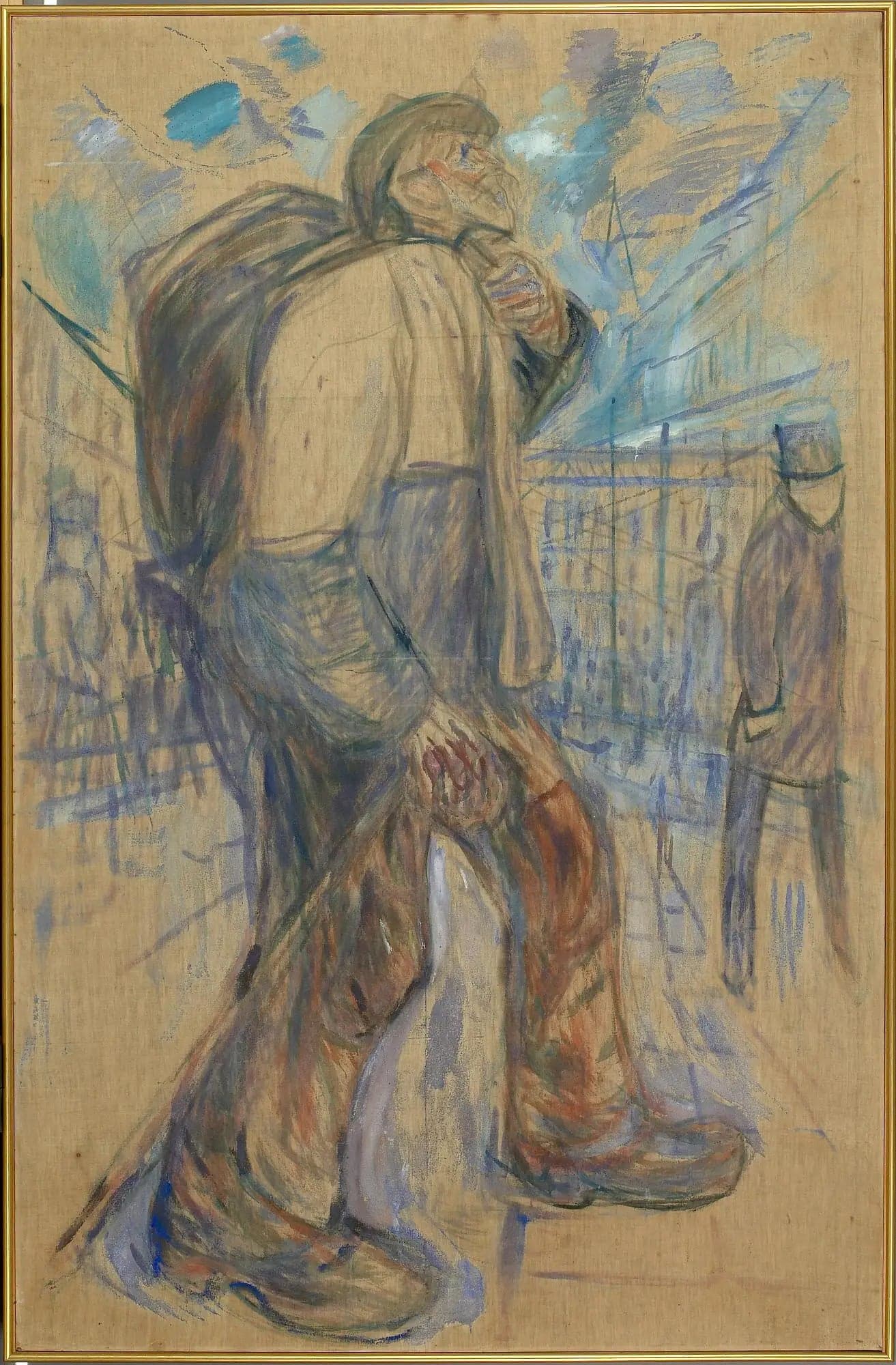
The Beggar
- Original dimensions
- 139.5 x 215 cm
Scene depicted
In The Beggar , Munch captures the essence of an absent humanity, where a character seems immersed in deep melancholy. The viewer is confronted with a portrait of isolation and suffering, illustrating the struggles of the most destitute. The figures around him bear a vacant and distant gaze, reflecting a society blind to the distress of others. This painting, very poignant, evokes themes of social exclusion and empathy, offering an emotional reflection on the state of our world.
Historical context
Œuvre : The Beggar |BRK| Artiste : Edvard Munch |BRK| Année : 1909 |BRK| Musée : Munch Museum |BRK| Dimensions : 139.5 x 215 cm |BRK| Expositions majeures : Edvard Munch . Monumental projects |BRK|
Place in the artist's career
The Beggar is at the heart of Edvard Munch 's career, marking a phase of introspection and artistic depth. This painting can be paralleled with other crucial works such as The Scream and The Vampire , which also evoke despair and emotional intensity. Munch, evolving towards a more refined technique, achieves through these compositions a stylistic maturity that continues to link his works together.
Anecdote
“Life itself has taught me to see the pain of others.” This quote resonates strongly when observing the genesis of The Beggar . It was during a silent walk in an alley of the city, where the morning light illuminated tired faces, that Edvard Munch was inspired. This moment of encounter, laden with emotions, is captured in this painting that trembles with pain and compassion.